Zig
Zig
ScMinidriver - Import Private Key to Smart Card
See more ScMinidriver Examples
Demonstrates how to import a private key to the "signature" or "key exchange" location in the Nth key container on a smart card.Chilkat Zig Downloads
const std = @import("std");
const chilkat = @import("chilkat");
pub fn main(init: std.process.Init) !void {
const alloc = init.arena.allocator();
// This example requires the Chilkat API to have been previously unlocked.
// See Global Unlock Sample for sample code.
// Chilkat recommends the following free tool for interactively examining the contents of your smart card
// through the ScMinidriver interface: MGTEK Tool for Minidriver enabled Smart Cards
// Let's first look at our smart card before importing a private key.
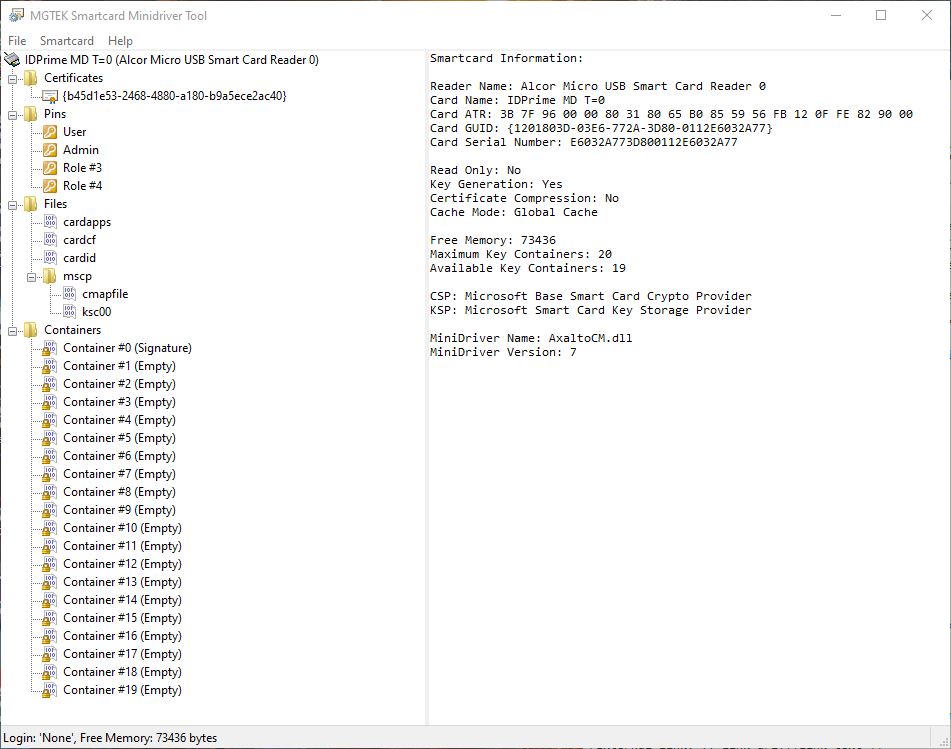
// Here's the view of our Gemalto (Thales) IDPrime MD T=0 smart card in the MGTEK tool:
//  // First let's load a private key into the Chilkat private key object.
// (Chilkat provides the ability to load private keys from many different sources and formats.
// this example loads from a PEM file.)
const priv_key = try chilkat.PrivateKey.init();
defer priv_key.deinit();
priv_key.loadPemFile("qa_data/rsa/rsaPrivKey_pkcs8.pem") catch {
std.debug.print("{s}\n", .{try priv_key.getLastErrorText(alloc)});
return;
};
const scmd = try chilkat.ScMinidriver.init();
defer scmd.deinit();
// First we need to acquire a context to the smart card in the reader where it is inserted.
// Reader names (smart card readers or USB tokens) can be discovered
// via List Readers or Find Smart Cards
const reader_name = "Alcor Micro USB Smart Card Reader 0";
scmd.acquireContext(reader_name) catch {
std.debug.print("{s}\n", .{try scmd.getLastErrorText(alloc)});
return;
};
// If successful, the name of the currently inserted smart card is available:
std.debug.print("Card name: {s}\n", .{try scmd.getCardName(alloc)});
// To import a private key, we'll need to be PIN authenticated.
// For more details about smart card PIN authentication, see the Smart Card PIN Authentication Example
const pin_id = "user";
const retval = scmd.pinAuthenticate(pin_id, "0000");
if (retval != 0) {
std.debug.print("PIN Authentication failed.\n", .{});
scmd.deleteContext() catch {};
return;
}
// Let's import into the "key exchange" position in key container #7.
scmd.importKey(7, "kex", priv_key, "user") catch {
std.debug.print("PIN Authentication failed.\n", .{});
scmd.deleteContext() catch {};
return;
};
scmd.deleteContext() catch {};
std.debug.print("Success.\n", .{});
// Here's the MGTEK view of the smart card after importing the private key:
//
// First let's load a private key into the Chilkat private key object.
// (Chilkat provides the ability to load private keys from many different sources and formats.
// this example loads from a PEM file.)
const priv_key = try chilkat.PrivateKey.init();
defer priv_key.deinit();
priv_key.loadPemFile("qa_data/rsa/rsaPrivKey_pkcs8.pem") catch {
std.debug.print("{s}\n", .{try priv_key.getLastErrorText(alloc)});
return;
};
const scmd = try chilkat.ScMinidriver.init();
defer scmd.deinit();
// First we need to acquire a context to the smart card in the reader where it is inserted.
// Reader names (smart card readers or USB tokens) can be discovered
// via List Readers or Find Smart Cards
const reader_name = "Alcor Micro USB Smart Card Reader 0";
scmd.acquireContext(reader_name) catch {
std.debug.print("{s}\n", .{try scmd.getLastErrorText(alloc)});
return;
};
// If successful, the name of the currently inserted smart card is available:
std.debug.print("Card name: {s}\n", .{try scmd.getCardName(alloc)});
// To import a private key, we'll need to be PIN authenticated.
// For more details about smart card PIN authentication, see the Smart Card PIN Authentication Example
const pin_id = "user";
const retval = scmd.pinAuthenticate(pin_id, "0000");
if (retval != 0) {
std.debug.print("PIN Authentication failed.\n", .{});
scmd.deleteContext() catch {};
return;
}
// Let's import into the "key exchange" position in key container #7.
scmd.importKey(7, "kex", priv_key, "user") catch {
std.debug.print("PIN Authentication failed.\n", .{});
scmd.deleteContext() catch {};
return;
};
scmd.deleteContext() catch {};
std.debug.print("Success.\n", .{});
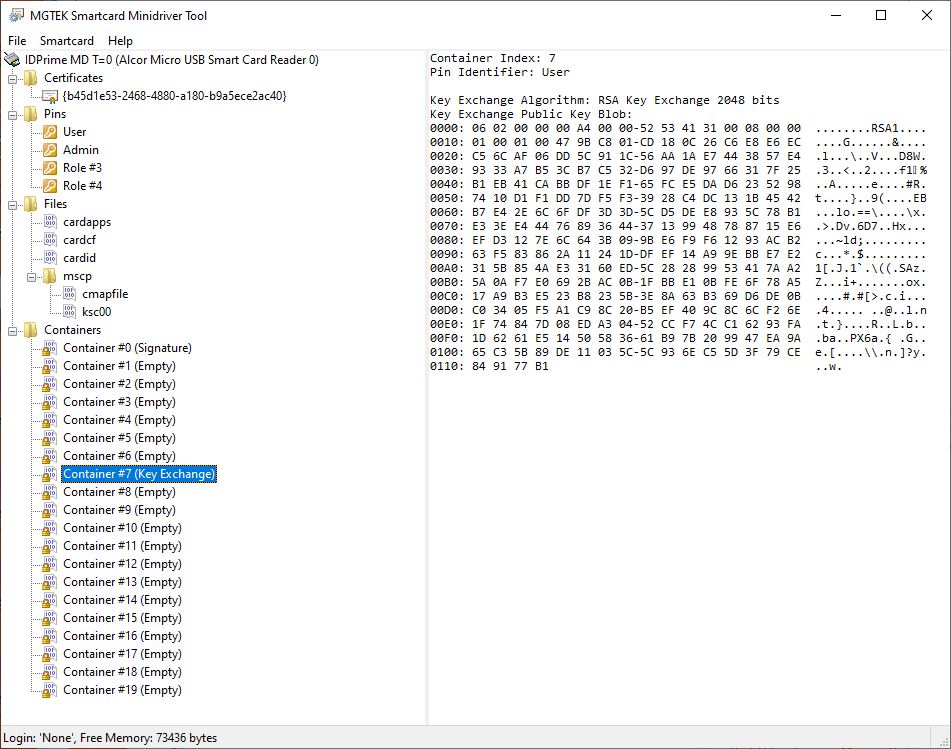
// Here's the MGTEK view of the smart card after importing the private key:
//  }
}