Unicode C
Unicode C
PDF Sign Unsigned Signature Field
See more PDF Signatures Examples
Demonstrates how to sign a PDF's unsigned signature field.Note: This example requires Chilkat v9.5.0.85 or greater.
Chilkat Unicode C Downloads
#include <C_CkPdfW.h>
#include <C_CkJsonObjectW.h>
#include <C_CkCertW.h>
void ChilkatSample(void)
{
BOOL success;
HCkPdfW pdf;
HCkJsonObjectW json;
HCkCertW cert;
success = FALSE;
// This example requires the Chilkat API to have been previously unlocked.
// See Global Unlock Sample for sample code.
pdf = CkPdfW_Create();
// Load a PDF containing an unsigned signature field.
success = CkPdfW_LoadFile(pdf,L"qa_data/pdf/unsigned_sig_field/due_diligence.pdf");
if (success == FALSE) {
wprintf(L"%s\n",CkPdfW_lastErrorText(pdf));
CkPdfW_Dispose(pdf);
return;
}
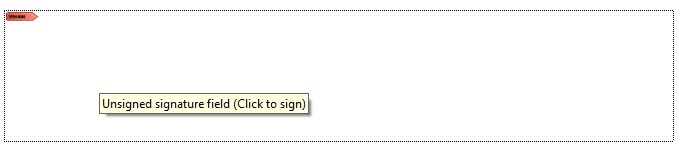
// A PDF with an unsigned signature field appears in Adobe Acrobat as shown below.
// (When the mouse pointer is hovered over the field, a tooltip will likely show a message
// such as "Unsigned signature field (Click to sign)".
// This example code will automatically find the unsigned signature field,
// and signs using your certificate. It automatically sizes the text to the space alotted
// for the signature.
//  // Options for signing are specified in JSON.
json = CkJsonObjectW_Create();
// In most cases, the signingCertificateV2 and signingTime attributes are required.
CkJsonObjectW_UpdateInt(json,L"signingCertificateV2",1);
CkJsonObjectW_UpdateInt(json,L"signingTime",1);
// We don't specify the page or a specific location because Chilkat will automatically
// find the unsigned signature field and use its location and size and will scale the
// signatures visual appearance (text + graphics) to the correct size required to fit.
// We only need to indicate the desire to fill the unsigned signature field.
CkJsonObjectW_UpdateBool(json,L"appearance.fillUnsignedSignatureField",TRUE);
// Starting in Chilkat v9.5.0.90, if a PDF contains multiple unsigned signature fields,
// the field to be signed can be chosen by name:
// To list unsigned signature fields, see this example: List PDF Unsigned Signature Fields
CkJsonObjectW_UpdateString(json,L"unsignedSignatureField",L"doctor_signature");
// Note: If the PDF document contains multiple unsigned signature fields, Chilkat will
// sign the 1st one found.
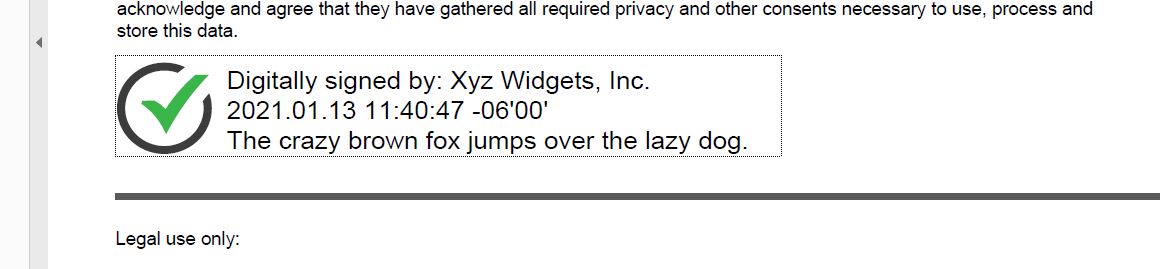
// In this example, the appearance of the digital signature will contain three lines:
// 1) The signing certificate's common name
// 2) The current date/time
// 3) Some arbitrary text.
// The keyword "cert_cn" is replaced with the Certificate's Subject Common Name.
// The keyword "current_dt" is replaced with the current date/time.
// Any number of appearance text lines can be added.
CkJsonObjectW_UpdateString(json,L"appearance.text[0]",L"Digitally signed by: cert_cn");
CkJsonObjectW_UpdateString(json,L"appearance.text[1]",L"current_dt");
CkJsonObjectW_UpdateString(json,L"appearance.text[2]",L"The crazy brown fox jumps over the lazy dog.");
// This signature will include one of the built-in SVG graphics (green-check-grey-circle).
CkJsonObjectW_UpdateString(json,L"appearance.image",L"green-check-grey-circle");
CkJsonObjectW_UpdateString(json,L"appearance.imagePlacement",L"left");
// Load the signing certificate. (Use your own certificate.)
cert = CkCertW_Create();
success = CkCertW_LoadPfxFile(cert,L"qa_data/pfx/myPdfSigningCert.pfx",L"secret");
if (success == FALSE) {
wprintf(L"%s\n",CkCertW_lastErrorText(cert));
CkPdfW_Dispose(pdf);
CkJsonObjectW_Dispose(json);
CkCertW_Dispose(cert);
return;
}
// Tell the pdf object to use the certificate for signing.
success = CkPdfW_SetSigningCert(pdf,cert);
if (success == FALSE) {
wprintf(L"%s\n",CkPdfW_lastErrorText(pdf));
CkPdfW_Dispose(pdf);
CkJsonObjectW_Dispose(json);
CkCertW_Dispose(cert);
return;
}
success = CkPdfW_SignPdf(pdf,json,L"qa_output/due_diligence_signed.pdf");
if (success == FALSE) {
wprintf(L"%s\n",CkPdfW_lastErrorText(pdf));
CkPdfW_Dispose(pdf);
CkJsonObjectW_Dispose(json);
CkCertW_Dispose(cert);
return;
}
wprintf(L"The PDF has been successfully cryptographically signed.\n");
// The appearance of the signature appears in Adobe Acrobat as shown below.
//
// Options for signing are specified in JSON.
json = CkJsonObjectW_Create();
// In most cases, the signingCertificateV2 and signingTime attributes are required.
CkJsonObjectW_UpdateInt(json,L"signingCertificateV2",1);
CkJsonObjectW_UpdateInt(json,L"signingTime",1);
// We don't specify the page or a specific location because Chilkat will automatically
// find the unsigned signature field and use its location and size and will scale the
// signatures visual appearance (text + graphics) to the correct size required to fit.
// We only need to indicate the desire to fill the unsigned signature field.
CkJsonObjectW_UpdateBool(json,L"appearance.fillUnsignedSignatureField",TRUE);
// Starting in Chilkat v9.5.0.90, if a PDF contains multiple unsigned signature fields,
// the field to be signed can be chosen by name:
// To list unsigned signature fields, see this example: List PDF Unsigned Signature Fields
CkJsonObjectW_UpdateString(json,L"unsignedSignatureField",L"doctor_signature");
// Note: If the PDF document contains multiple unsigned signature fields, Chilkat will
// sign the 1st one found.
// In this example, the appearance of the digital signature will contain three lines:
// 1) The signing certificate's common name
// 2) The current date/time
// 3) Some arbitrary text.
// The keyword "cert_cn" is replaced with the Certificate's Subject Common Name.
// The keyword "current_dt" is replaced with the current date/time.
// Any number of appearance text lines can be added.
CkJsonObjectW_UpdateString(json,L"appearance.text[0]",L"Digitally signed by: cert_cn");
CkJsonObjectW_UpdateString(json,L"appearance.text[1]",L"current_dt");
CkJsonObjectW_UpdateString(json,L"appearance.text[2]",L"The crazy brown fox jumps over the lazy dog.");
// This signature will include one of the built-in SVG graphics (green-check-grey-circle).
CkJsonObjectW_UpdateString(json,L"appearance.image",L"green-check-grey-circle");
CkJsonObjectW_UpdateString(json,L"appearance.imagePlacement",L"left");
// Load the signing certificate. (Use your own certificate.)
cert = CkCertW_Create();
success = CkCertW_LoadPfxFile(cert,L"qa_data/pfx/myPdfSigningCert.pfx",L"secret");
if (success == FALSE) {
wprintf(L"%s\n",CkCertW_lastErrorText(cert));
CkPdfW_Dispose(pdf);
CkJsonObjectW_Dispose(json);
CkCertW_Dispose(cert);
return;
}
// Tell the pdf object to use the certificate for signing.
success = CkPdfW_SetSigningCert(pdf,cert);
if (success == FALSE) {
wprintf(L"%s\n",CkPdfW_lastErrorText(pdf));
CkPdfW_Dispose(pdf);
CkJsonObjectW_Dispose(json);
CkCertW_Dispose(cert);
return;
}
success = CkPdfW_SignPdf(pdf,json,L"qa_output/due_diligence_signed.pdf");
if (success == FALSE) {
wprintf(L"%s\n",CkPdfW_lastErrorText(pdf));
CkPdfW_Dispose(pdf);
CkJsonObjectW_Dispose(json);
CkCertW_Dispose(cert);
return;
}
wprintf(L"The PDF has been successfully cryptographically signed.\n");
// The appearance of the signature appears in Adobe Acrobat as shown below.
//  CkPdfW_Dispose(pdf);
CkJsonObjectW_Dispose(json);
CkCertW_Dispose(cert);
}
CkPdfW_Dispose(pdf);
CkJsonObjectW_Dispose(json);
CkCertW_Dispose(cert);
}