Unicode C++
 Unicode C++
Authorization Code Flow with PKCE for Native Apps
See more Okta OAuth/OIDC Examples
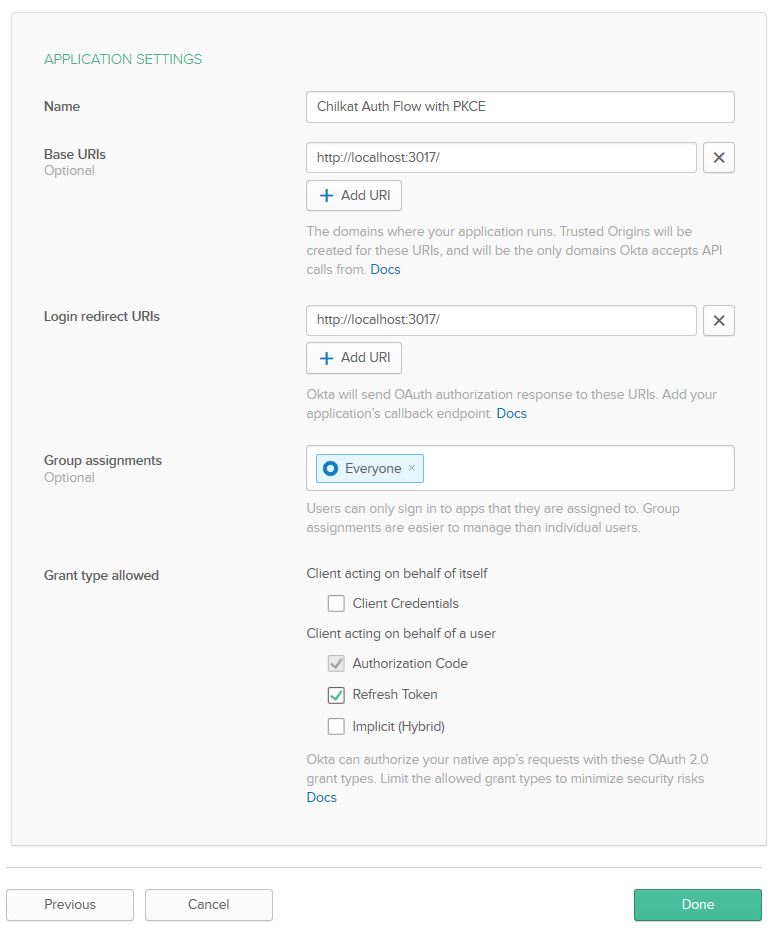
Demonstrates the authorization code flow with Proof Key for Code Exchange (PKCE) for native apps. In Okta, your app should be defined as shown:
Chilkat Unicode C++ Downloads
#include <CkOAuth2W.h>
#include <CkJsonObjectW.h>
#include <CkFileAccessW.h>

void ChilkatSample(void)
    {
    bool success = false;

    //  This example requires the Chilkat API to have been previously unlocked.
    //  See Global Unlock Sample for sample code.

    CkOAuth2W oauth2;

    //  This should be the port in the Login redirect URI for your app.
    //  Your app's Login redirect URI should be "http://localhost:3017/" if the port number is 3017.
    oauth2.put_ListenPort(3017);

    oauth2.put_AuthorizationEndpoint(L"https://{yourOktaDomain}/oauth2/default/v1/authorize");
    oauth2.put_TokenEndpoint(L"https://{yourOktaDomain}/oauth2/default/v1/token");

    //  Replace these with actual values.
    oauth2.put_ClientId(L"OKTA_CLIENT_ID");
    oauth2.put_ClientSecret(L"OKTA_CLIENT_SECRET");

    oauth2.put_CodeChallenge(true);
    oauth2.put_IncludeNonce(true);

    //  Make sure to include "offline_access" to get a refresh token included in the final JSON response.
    //  Add any additional needed scopes separated by space chars.
    oauth2.put_Scope(L"openid offline_access");

    //  Begin the OAuth2 three-legged flow.  This returns a URL that should be loaded in a browser.
    const wchar_t *url = oauth2.startAuth();
    if (oauth2.get_LastMethodSuccess() == false) {
        wprintf(L"%s\n",oauth2.lastErrorText());
        return;
    }

    wprintf(L"URL to load in browser: %s\n",url);

    //  Launch the system's default browser navigated to the URL.
    success = oauth2.LaunchBrowser(url);
    if (success == false) {
        wprintf(L"%s\n",oauth2.lastErrorText());
        return;
    }

    //  Now wait for the authorization.
    //  We'll wait for a max of 60 seconds.
    int numMsWaited = 0;
    while ((numMsWaited < 60000) && (oauth2.get_AuthFlowState() < 3)) {
        oauth2.SleepMs(100);
        numMsWaited = numMsWaited + 100;
    }

    //  If there was no response from the browser within 30 seconds, then
    //  the AuthFlowState will be equal to 1 or 2.
    //  1: Waiting for Redirect. The OAuth2 background thread is waiting to receive the redirect HTTP request from the browser.
    //  2: Waiting for Final Response. The OAuth2 background thread is waiting for the final access token response.
    //  In that case, cancel the background task started in the call to StartAuth.
    if (oauth2.get_AuthFlowState() < 3) {
        oauth2.Cancel();
        wprintf(L"No response from the browser!\n");
        return;
    }

    //  Check the AuthFlowState to see if authorization was granted, denied, or if some error occurred
    //  The possible AuthFlowState values are:
    //  3: Completed with Success. The OAuth2 flow has completed, the background thread exited, and the successful JSON response is available in AccessTokenResponse property.
    //  4: Completed with Access Denied. The OAuth2 flow has completed, the background thread exited, and the error JSON is available in AccessTokenResponse property.
    //  5: Failed Prior to Completion. The OAuth2 flow failed to complete, the background thread exited, and the error information is available in the FailureInfo property.
    if (oauth2.get_AuthFlowState() == 5) {
        wprintf(L"OAuth2 failed to complete.\n");
        wprintf(L"%s\n",oauth2.failureInfo());
        return;
    }

    if (oauth2.get_AuthFlowState() == 4) {
        wprintf(L"OAuth2 authorization was denied.\n");
        wprintf(L"%s\n",oauth2.accessTokenResponse());
        return;
    }

    if (oauth2.get_AuthFlowState() != 3) {
        wprintf(L"Unexpected AuthFlowState:%d\n",oauth2.get_AuthFlowState());
        return;
    }

    wprintf(L"OAuth2 authorization granted!\n");
    wprintf(L"Access Token = %s\n",oauth2.accessToken());

    //  Get the full JSON response:
    CkJsonObjectW json;
    json.Load(oauth2.accessTokenResponse());
    json.put_EmitCompact(false);
    wprintf(L"%s\n",json.emit());

    //  The JSON response looks like this:

    //  {
    //    "access_token": "eyJraWQi ... Kn4IiEfOw",
    //    "token_type": "Bearer",
    //    "expires_in": 3600,
    //    "scope": "offline_access openid",
    //    "refresh_token": "0jCqotuuUegdjNzB9uuSsfGM2Cu5HnCHUxoJ0yhZ4rs",
    //    "id_token": "eyJraWQiO ... 09WGEq3dTRmQF86PzJg"
    //  }

    //  Save the JSON to a file for future requests.
    CkFileAccessW fac;
    fac.WriteEntireTextFile(L"qa_data/tokens/okta.json",json.emit(),L"utf-8",false);
    }