Unicode C++
Unicode C++
Firebase GET - Reading Data
See more Firebase Examples
Demonstrates how to read parts of a Firebase JSON database. The data used in this example is at Chilkat Firebase Pigs Database, and is shown here: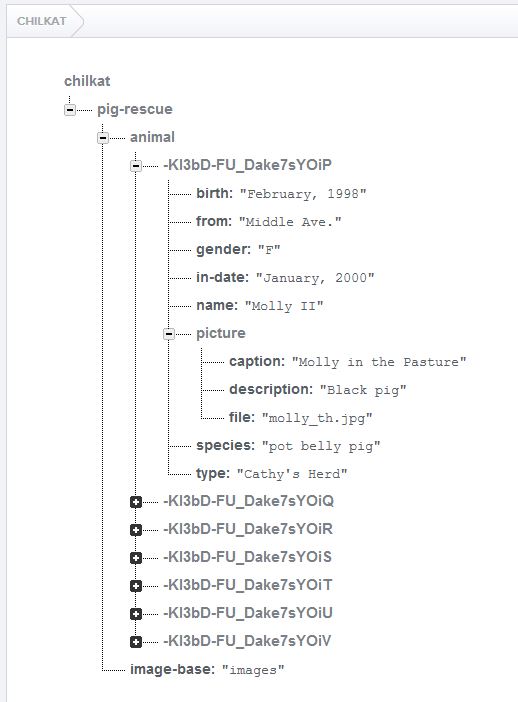
Chilkat Unicode C++ Downloads
#include <CkFileAccessW.h>
#include <CkRestW.h>
#include <CkAuthGoogleW.h>
#include <CkStringBuilderW.h>
#include <CkJsonObjectW.h>

void ChilkatSample(void)
    {
    bool success = false;

    //  Demonstrates how to read parts of a Firebase JSON database.

    //  This example requires the Chilkat API to have been previously unlocked.
    //  See Global Unlock Sample for sample code.

    //  This example assumes a JWT authentication token, if required, has been previously obtained.
    //  See Get Firebase Access Token from JSON Service Account Private Key for sample code.

    //  Load the previously obtained Firebase access token into a string.
    CkFileAccessW fac;
    const wchar_t *accessToken = fac.readEntireTextFile(L"qa_data/tokens/firebaseToken.txt",L"utf-8");
    if (fac.get_LastMethodSuccess() != true) {
        wprintf(L"%s\n",fac.lastErrorText());
        return;
    }

    CkRestW rest;

    //  Make the initial connection (without sending a request yet).
    //  Once connected, any number of requests may be sent.  It is not necessary to explicitly
    //  call Connect before each request.
    success = rest.Connect(L"chilkat.firebaseio.com",443,true,true);
    if (success != true) {
        wprintf(L"%s\n",rest.lastErrorText());
        return;
    }

    //  If authentication is required...
    CkAuthGoogleW authGoogle;
    authGoogle.put_AccessToken(accessToken);
    rest.SetAuthGoogle(authGoogle);

    //  Chilkat's sample data (pig-rescue data) is publicly readable at: https://chilkat.firebaseio.com/.json

    //  Let's get the animals with the shallow parameter so we can see how many pigs exist.
    const wchar_t *jsonResponse = rest.fullRequestNoBody(L"GET",L"/pig-rescue/animal.json?shallow=true");
    if (rest.get_LastMethodSuccess() != true) {
        wprintf(L"%s\n",rest.lastErrorText());
        return;
    }

    //  The JSON returned should look like this:
    //  {"-KI3bD-FU_Dake7sYOiP":true,"-KI3bD-FU_Dake7sYOiT":true,"-KI3bD-FU_Dake7sYOiS":true,"-KI3bD-FU_Dake7sYOiU":true,"-KI3bD-FU_Dake7sYOiV":true,"-KI3bD-FU_Dake7sYOiR":true,"-KI3bD-FU_Dake7sYOiQ":true}
    wprintf(L"%s\n",jsonResponse);

    //  Parse the response so we can iterate over each pig in the database..
    CkStringBuilderW piggyPath;
    CkJsonObjectW shallow;
    CkJsonObjectW piggyData;
    shallow.Load(jsonResponse);
    int count = shallow.get_Size();
    int i = 0;
    while (i < count) {

        //  Get each individual pig's data.
        piggyPath.Clear();
        piggyPath.Append(L"/pig-rescue/animal/");
        piggyPath.Append(shallow.nameAt(i));
        piggyPath.Append(L"/.json");

        const wchar_t *piggyJson = rest.fullRequestNoBody(L"GET",piggyPath.getAsString());
        if (rest.get_LastMethodSuccess() != true) {
            wprintf(L"%s\n",rest.lastErrorText());
            return;
        }

        //  Show this piggy's data...
        //  An example of one pig's data is shown here:
        //  {"birth":"February, 1998","from":"Middle Ave.","gender":"F","in-date":"January, 2000",
        //    "name":"Molly II","picture":{"caption":"Molly in the Pasture","description":"Black pig","file":"molly_th.jpg"},
        //    "species":"pot belly pig","type":"Cathy's Herd"}
        wprintf(L"---- %d ----\n",i);
        wprintf(L"%s\n",piggyJson);

        //  Let's get the pig's name, and the caption of the picture.
        piggyData.Load(piggyJson);
        wprintf(L"name: %s\n",piggyData.stringOf(L"name"));
        wprintf(L"caption: %s\n",piggyData.stringOf(L"picture.caption"));

        i = i + 1;
    }

    //  Note: In many of the Chilkat examples, you may notice strange ways
    //  of doing something that should be simpler and shorter.  For example,
    //  building the piggyPath (above) could've been written differently,
    //  with some simple string concatenation.
    //
    //  The reason is that the Chilkat examples are written in a
    //  proprietary "example code" scripting language,
    //  and then automatically generated to each of the different programming
    //  languages you see on example-code.com.  The code generation is
    //  limited in what it can do.  For example, string concatentation
    //  is not yet a feature of the "example code" scripting language (as of May 2016),
    //  and therefore you won't see the use of a programming language's string
    //  concatentation operators in any example.
    //
    }