Unicode C Requires Chilkat v10.1.2+
Unicode C
Salesforce OAuth2 Access Token
See more OAuth2 Examples
Demonstrates how to get a Salesforce OAuth2 access token from a desktop application or script.Chilkat Unicode C Downloads
#include <C_CkOAuth2W.h>
#include <C_CkStringBuilderW.h>
void ChilkatSample(void)
{
BOOL success;
HCkOAuth2W oauth2;
const wchar_t *url;
int numMsWaited;
HCkStringBuilderW sbJson;
success = FALSE;
// To further clarify, see OAuth 2.0 Authorization Flow
oauth2 = CkOAuth2W_Create();
// This should be the port in the localhost callback URL for your connected app.
// The callback URL would look like "http://localhost:3017/" if the port number is 3017.
CkOAuth2W_putListenPort(oauth2,3017);
CkOAuth2W_putAuthorizationEndpoint(oauth2,L"https://login.salesforce.com/services/oauth2/authorize");
CkOAuth2W_putTokenEndpoint(oauth2,L"https://login.salesforce.com/services/oauth2/token");
// Replace this with your actual client ID (Consumer Key)
CkOAuth2W_putClientId(oauth2,L"CLIENT_ID");
// We don't have to include the client secret.
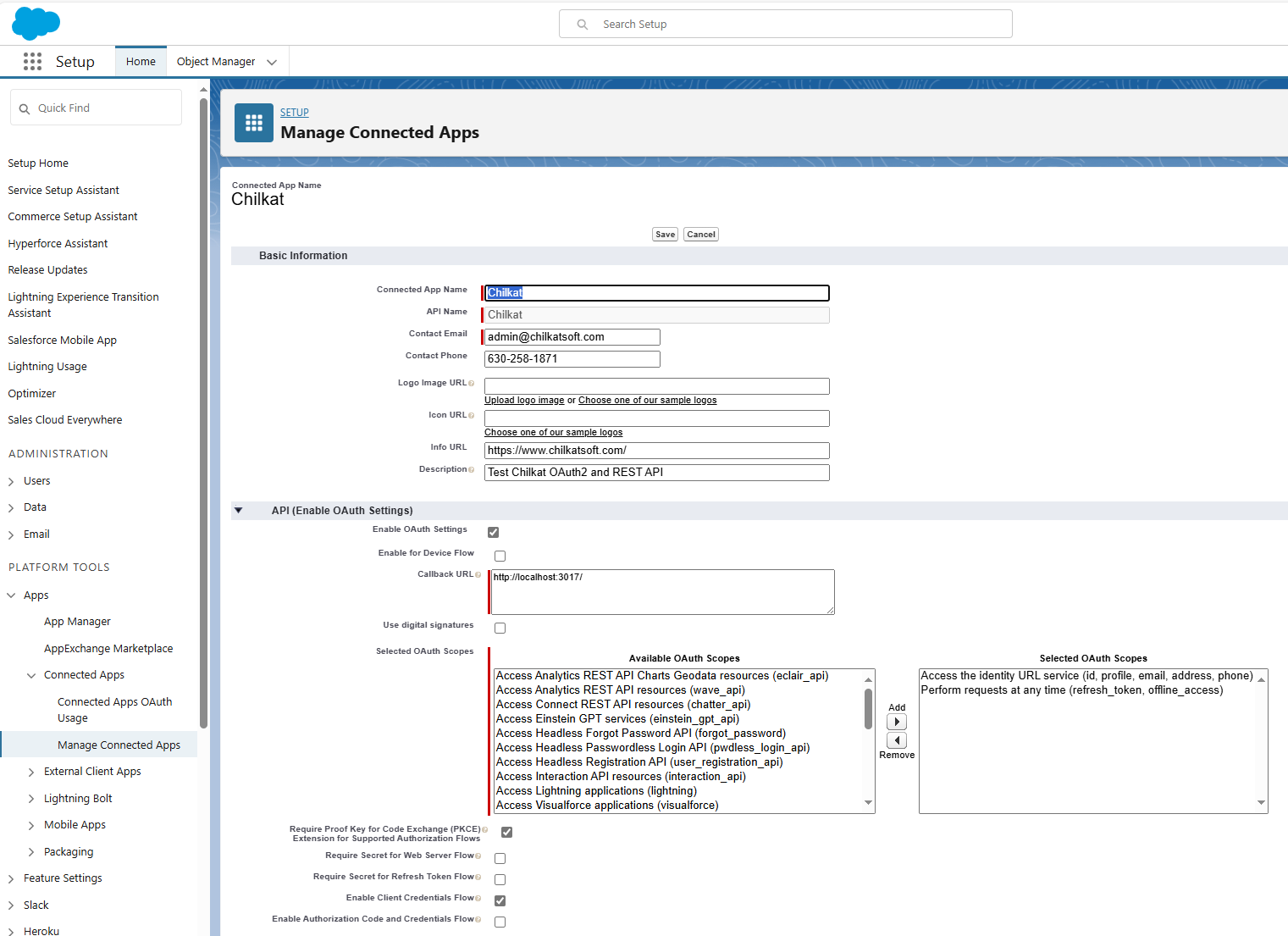
// See the screenshot of our Connected App below..
// This is for Require Proof Key for Code Exchange (PKCE)
// See OAuth2 PKCE Explained
CkOAuth2W_putCodeChallenge(oauth2,TRUE);
CkOAuth2W_putCodeChallengeMethod(oauth2,L"S256");
// To force the OAuth consent screen to reappear (even if previously granted), use:
CkOAuth2W_AddAuthQueryParam(oauth2,L"prompt",L"consent");
// Begin the OAuth2 authorization flow. This returns a URL that should be loaded in a browser.
url = CkOAuth2W_startAuth(oauth2);
if (CkOAuth2W_getLastMethodSuccess(oauth2) != TRUE) {
wprintf(L"%s\n",CkOAuth2W_lastErrorText(oauth2));
CkOAuth2W_Dispose(oauth2);
return;
}
// Launch the default browser on the system and navigate to the url.
// The LaunchBrowser method was added in Chilkat v10.1.2.
success = CkOAuth2W_LaunchBrowser(oauth2,url);
if (success == FALSE) {
wprintf(L"%s\n",CkOAuth2W_lastErrorText(oauth2));
CkOAuth2W_Dispose(oauth2);
return;
}
// Wait for the user to approve or deny authorization in the browser.
numMsWaited = 0;
while ((numMsWaited < 90000) && (CkOAuth2W_getAuthFlowState(oauth2) < 3)) {
CkOAuth2W_SleepMs(oauth2,100);
numMsWaited = numMsWaited + 100;
}
// If the browser does not respond within the specified time, AuthFlowState will be:
//
// 1: Waiting for Redirect – The OAuth2 background thread is waiting for the browser's redirect request.
// 2: Waiting for Final Response – The thread is awaiting the final access token response.
// In either case, cancel the background task initiated by StartAuth.
if (CkOAuth2W_getAuthFlowState(oauth2) < 3) {
CkOAuth2W_Cancel(oauth2);
wprintf(L"No response from the browser!\n");
CkOAuth2W_Dispose(oauth2);
return;
}
// Check AuthFlowState to determine if authorization was granted, denied, or failed:
//
// 3: Success – OAuth2 flow completed, the background thread exited, and the successful response is in AccessTokenResponse.
// 4: Access Denied – OAuth2 flow completed, the background thread exited, and the error response is in AccessTokenResponse.
// 5: Failure – OAuth2 flow failed before completion, the background thread exited, and error details are in FailureInfo.
if (CkOAuth2W_getAuthFlowState(oauth2) == 5) {
wprintf(L"OAuth2 failed to complete.\n");
wprintf(L"%s\n",CkOAuth2W_failureInfo(oauth2));
CkOAuth2W_Dispose(oauth2);
return;
}
if (CkOAuth2W_getAuthFlowState(oauth2) == 4) {
wprintf(L"OAuth2 authorization was denied.\n");
wprintf(L"%s\n",CkOAuth2W_accessTokenResponse(oauth2));
CkOAuth2W_Dispose(oauth2);
return;
}
if (CkOAuth2W_getAuthFlowState(oauth2) != 3) {
wprintf(L"Unexpected AuthFlowState:%d\n",CkOAuth2W_getAuthFlowState(oauth2));
CkOAuth2W_Dispose(oauth2);
return;
}
wprintf(L"OAuth2 authorization granted!\n");
wprintf(L"Access Token = %s\n",CkOAuth2W_accessToken(oauth2));
// Save the full JSON access token response to a file.
sbJson = CkStringBuilderW_Create();
CkStringBuilderW_Append(sbJson,CkOAuth2W_accessTokenResponse(oauth2));
CkStringBuilderW_WriteFile(sbJson,L"qa_data/tokens/_salesforce.json",L"utf-8",FALSE);
// The saved JSON response looks like this:
// {
// "access_token": "00D41000....uLZBpT6",
// "refresh_token": "5Aep....25xdGgkrV",
// "signature": "cjTbSc5DvcKpaMoRTzuQTJLb1tcMw8LEO01flq4aMD4=",
// "scope": "refresh_token id",
// "instance_url": "https://d41000000f8a0eak-dev-ed.my.salesforce.com",
// "id": "https://login.salesforce.com/id/00D41000000F8A0EAK/005410000....xAAE",
// "token_type": "Bearer",
// "issued_at": "1738348388166"
// }
// --------------------------------------------------------------------------
// Here's a screenshot of a Salesforce Connected App
// with the correct Callback URL for this example,
// and also selects "Require Proof Key for Code Exchange (PKCE)"
// and does not requires the secret for the authorization or refresh flow,
// and also allows for the Client Credentials flow.
//  CkOAuth2W_Dispose(oauth2);
CkStringBuilderW_Dispose(sbJson);
}
CkOAuth2W_Dispose(oauth2);
CkStringBuilderW_Dispose(sbJson);
}