SQL Server
SQL Server
Auto-Refresh O365 Access Token when Sending Email
See more Office365 Examples
Demonstrates how to automatically recover from an expired access token when sending email from smtp.office365.com using OAuth2 authentication. If the server responds with an error indicating that the access token is expired, then we refresh the access token and retry.Chilkat SQL Server Downloads
--
CREATE PROCEDURE ChilkatSample
AS
BEGIN
    DECLARE @hr int
    DECLARE @iTmp0 int
    DECLARE @sTmp0 nvarchar(4000)
    DECLARE @success int
    SELECT @success = 0

    --  This example requires the Chilkat API to have been previously unlocked.
    --  See Global Unlock Sample for sample code.

    --  An Office365 OAuth2 access token must first be obtained prior
    --  to running this code.

    --  First get our previously obtained OAuth2 access token.
    DECLARE @jsonToken int
    EXEC @hr = sp_OACreate 'Chilkat.JsonObject', @jsonToken OUT
    IF @hr <> 0
    BEGIN
        PRINT 'Failed to create ActiveX component'
        RETURN
    END

    EXEC sp_OAMethod @jsonToken, 'LoadFile', @success OUT, 'qa_data/tokens/office365.json'

    DECLARE @mailman int
    EXEC @hr = sp_OACreate 'Chilkat.MailMan', @mailman OUT

    EXEC sp_OASetProperty @mailman, 'SmtpHost', 'smtp.office365.com'
    EXEC sp_OASetProperty @mailman, 'SmtpPort', 587
    EXEC sp_OASetProperty @mailman, 'StartTLS', 1

    --  Use your Office365 email address for the SmtpUsername.
    EXEC sp_OASetProperty @mailman, 'SmtpUsername', 'OFFICE365_EMAIL_ADDRESS'
    EXEC sp_OAMethod @jsonToken, 'StringOf', @sTmp0 OUT, 'access_token'
    EXEC sp_OASetProperty @mailman, 'OAuth2AccessToken', @sTmp0

    --  Create a new email object
    DECLARE @email int
    EXEC @hr = sp_OACreate 'Chilkat.Email', @email OUT

    EXEC sp_OASetProperty @email, 'Subject', 'This is a test'
    EXEC sp_OASetProperty @email, 'Body', 'This is a test'
    EXEC sp_OASetProperty @email, 'From', 'MY_NAME <OFFICE365_EMAIL_ADDRESS>'
    EXEC sp_OAMethod @email, 'AddTo', @success OUT, 'John Doe', 'somebody@example.com'

    --  Call SendEmail to connect to the SMTP server and send.
    --  The connection (i.e. session) to the SMTP server remains
    --  open so that subsequent SendEmail calls may use the
    --  same connection.
    EXEC sp_OAMethod @mailman, 'SendEmail', @success OUT, @email
    IF @success = 1
      BEGIN

        PRINT 'Mail Sent!'
        EXEC @hr = sp_OADestroy @jsonToken
        EXEC @hr = sp_OADestroy @mailman
        EXEC @hr = sp_OADestroy @email
        RETURN
      END

    --  If we fall through to here, it means something failed.
    --  If we failed because of an invalid or expired access token, we should get this SMTP status code and error message:
    --     response: 535 5.7.3 Authentication unsuccessful [CH2PR19CA0023.namprd19.prod.outlook.com]
    --     status code: 535
    EXEC sp_OAGetProperty @mailman, 'LastSmtpStatus', @iTmp0 OUT
    IF @iTmp0 <> 535
      BEGIN
        EXEC sp_OAGetProperty @mailman, 'LastErrorText', @sTmp0 OUT
        PRINT @sTmp0
        EXEC @hr = sp_OADestroy @jsonToken
        EXEC @hr = sp_OADestroy @mailman
        EXEC @hr = sp_OADestroy @email
        RETURN
      END

    --  If we get here, it means the SMTP status code equaled 535, which is an authentication failure.
    --  Let's refresh the access token, and then retry..

    DECLARE @oauth2 int
    EXEC @hr = sp_OACreate 'Chilkat.OAuth2', @oauth2 OUT

    --  Update to use your token endpoint.
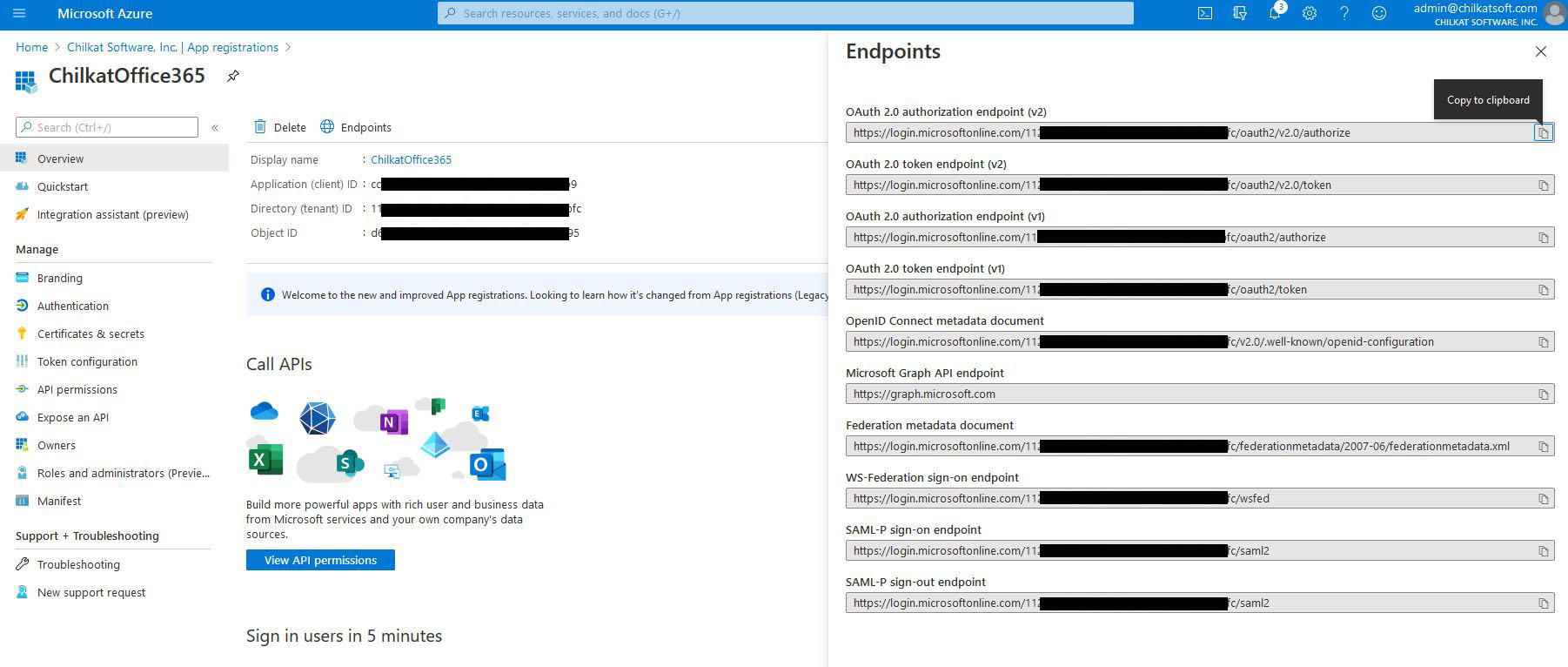
    --  In the Azure Portal, in "App registrations", go to "Endpoints" (located to the right of the "+ New registration" link.)
    --     Find your endpoint for the "OAuth 2.0 token endpoint (v2)"
    --     See Office365 OAuth2 Endpoints

    EXEC sp_OASetProperty @oauth2, 'TokenEndpoint', 'https://login.microsoftonline.com/xxxxxxxxxx-71bf-4ebe-a866-738364321bf2/oauth2/v2.0/token'

    --  Replace these with actual values.
    EXEC sp_OASetProperty @oauth2, 'ClientId', 'CLIENT_ID'
    EXEC sp_OASetProperty @oauth2, 'ClientSecret', 'CLIENT_SECRET'

    --  Get the "refresh_token"
    EXEC sp_OAMethod @jsonToken, 'StringOf', @sTmp0 OUT, 'refresh_token'
    EXEC sp_OASetProperty @oauth2, 'RefreshToken', @sTmp0

    --  Send the HTTP POST to refresh the access token..
    EXEC sp_OAMethod @oauth2, 'RefreshAccessToken', @success OUT
    IF @success <> 1
      BEGIN
        EXEC sp_OAGetProperty @oauth2, 'LastErrorText', @sTmp0 OUT
        PRINT @sTmp0
        EXEC @hr = sp_OADestroy @jsonToken
        EXEC @hr = sp_OADestroy @mailman
        EXEC @hr = sp_OADestroy @email
        EXEC @hr = sp_OADestroy @oauth2
        RETURN
      END


    EXEC sp_OAGetProperty @oauth2, 'AccessToken', @sTmp0 OUT
    PRINT 'New access token: ' + @sTmp0

    EXEC sp_OAGetProperty @oauth2, 'RefreshToken', @sTmp0 OUT
    PRINT 'New refresh token: ' + @sTmp0

    --  Update the JSON with the new tokens.
    EXEC sp_OAGetProperty @oauth2, 'AccessToken', @sTmp0 OUT
    EXEC sp_OAMethod @jsonToken, 'UpdateString', @success OUT, 'access_token', @sTmp0
    EXEC sp_OAGetProperty @oauth2, 'RefreshToken', @sTmp0 OUT
    EXEC sp_OAMethod @jsonToken, 'UpdateString', @success OUT, 'refresh_token', @sTmp0

    --  Save the new JSON access token response to a file.
    DECLARE @sbJson int
    EXEC @hr = sp_OACreate 'Chilkat.StringBuilder', @sbJson OUT

    EXEC sp_OASetProperty @jsonToken, 'EmitCompact', 0
    EXEC sp_OAMethod @jsonToken, 'EmitSb', @success OUT, @sbJson
    EXEC sp_OAMethod @sbJson, 'WriteFile', @success OUT, 'qa_data/tokens/office365.json', 'utf-8', 0


    PRINT 'OAuth2 authorization granted!'

    EXEC sp_OAGetProperty @oauth2, 'AccessToken', @sTmp0 OUT
    PRINT 'New Access Token = ' + @sTmp0

    --  -------------------------------------------------
    --  Retry the SMTP send using the refreshed access token.


    PRINT 'Retrying the send using the refreshed access token.'

    EXEC sp_OAGetProperty @oauth2, 'AccessToken', @sTmp0 OUT
    EXEC sp_OASetProperty @mailman, 'OAuth2AccessToken', @sTmp0

    EXEC sp_OAMethod @mailman, 'SendEmail', @success OUT, @email
    IF @success = 0
      BEGIN
        EXEC sp_OAGetProperty @mailman, 'LastErrorText', @sTmp0 OUT
        PRINT @sTmp0
        EXEC @hr = sp_OADestroy @jsonToken
        EXEC @hr = sp_OADestroy @mailman
        EXEC @hr = sp_OADestroy @email
        EXEC @hr = sp_OADestroy @oauth2
        EXEC @hr = sp_OADestroy @sbJson
        RETURN
      END

    EXEC sp_OAMethod @mailman, 'CloseSmtpConnection', @success OUT
    IF @success <> 1
      BEGIN

        PRINT 'Connection to SMTP server not closed cleanly.'
      END


    PRINT 'Email sent!'

    EXEC @hr = sp_OADestroy @jsonToken
    EXEC @hr = sp_OADestroy @mailman
    EXEC @hr = sp_OADestroy @email
    EXEC @hr = sp_OADestroy @oauth2
    EXEC @hr = sp_OADestroy @sbJson


END
GO