Rust
Rust
XML Tree Traversal Order for Search* Methods
See more XML Examples
The Chilkat XML API provides a number of Search* methods for locating XML nodes based on criteria. These methods traverse an XML document in a breadth-first order. (See Breadth-First Search).The XML document used in this example has the following tree structure:
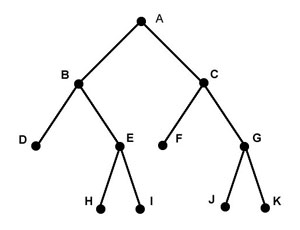
The nodes are traversed in the order: A, B, C, D, E, F, G, H, I, J, K.
The input XML, available at http://www.chilkatsoft.com/data/searchOrder.xml, is this:
<a>crocodileA
    <b>crocodileB
        <d>crocodileD</d>
        <e>crocodileE
            <h>crocodileH</h>
            <i>crocodileI</i>
        </e>
    </b>
    <c>crocodileC
        <f>crocodileF</f>
        <g>crocodileG
            <j>crocodileJ</j>
            <k>crocodileK</k>
        </g>
    </c>
</a>
Chilkat Rust Downloads
let xml = chilkat::Xml::new();

// The sample input XML is available at http://www.chilkatsoft.com/data/searchOrder.xml
if xml.load_xml_file("searchOrder.xml").is_err() {
    println!("{}", xml.last_error_text());
    return;
}

// IMPORTANT:  The following loop for iterating over all
// matching nodes performs reasonably well for small to
// mid-size XML documents or sub-trees.  Performance
// can be poor when the sub-tree contains many thousands
// of nodes (or more).

// NOTE:  The search is always rooted at the calling node.
// In this example, it happens to also be the root node of the entire
// XML document.  Searches can be performed on sub-trees
// within the document by calling the Search* method from
// the root node of a sub-tree.

// Demonstrate the breadth-first traversal:
let mut x_begin_after = xml.get_self().unwrap();
let mut x_found = xml.search_all_for_content(Some(&x_begin_after), "*croc*").unwrap();
while xml.last_method_success() {

    println!("{}", x_found.tag());

    x_begin_after = x_found;
    x_found = xml.search_all_for_content(Some(&x_begin_after), "*croc*").unwrap();
}