Rust
Rust
Google Sheets - Append Values to an Existing Spreadsheet
See more Google Sheets Examples
Appends values to an existing Google spreadsheet.Chilkat Rust Downloads
// This example requires the Chilkat API to have been previously unlocked.
// See Global Unlock Sample for sample code.
// This example uses a previously obtained access token having permission for the
// Google Sheets scope.
// In this example, Get Google Sheets OAuth2 Access Token, the access
// token was saved to a JSON file. This example fetches the access token from the file..
let json_token = chilkat::JsonObject::new();
let _ = json_token.load_file("qa_data/tokens/googleSheets.json").is_ok();
if !json_token.has_member("access_token") {
println!("No access token found.");
return;
}
let http = chilkat::Http::new();
http.set_auth_token(&json_token.string_of("access_token").unwrap_or_default());
// To append values to an existing spreadsheet, our HTTP request body will
// contain JSON in the format of a "ValueRange". For example, the spreadsheet we'll be
// adding to in this example looks like this:
// 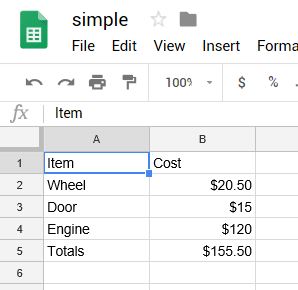 // The JSON ValueRange for the cells in the above spreadsheet is:
// {
// "range": "Sheet1!A1:B5",
// "majorDimension": "ROWS",
// "values": [
// [
// "Item",
// "Cost"
// ],
// [
// "Wheel",
// "$20.50"
// ],
// [
// "Door",
// "$15"
// ],
// [
// "Engine",
// "$100"
// ],
// [
// "Totals",
// "$135.50"
// ]
// ]
// }
// This example will append 6 cells (3 rows / 2 columns).
// We'll be appending the following:
//
// "Paint", "$100"
// "Brakes", "$100"
// "New Total", "$335.50"
//
// The range of cells we'll be appending is A1:B5
// Therefore, the ValueRange JSON we'll be sending in our POST body is:
// {
// "range": "Sheet1!A1:B5",
// "majorDimension": "ROWS",
// "values": [
// [
// "Paint",
// "$100"
// ],
// [
// "Brakes",
// "$100"
// ],
// [
// "New Total",
// "$335.50"
// ]
// ]
// }
let json = chilkat::JsonObject::new();
let _ = json.update_string("range", "Sheet1!A1:B5");
let _ = json.update_string("majorDimension", "ROWS");
json.set_i(0);
json.set_j(1);
let _ = json.update_string("values[i][j]", "Paint");
json.set_j(1);
let _ = json.update_string("values[i][j]", "$100");
json.set_i(1);
json.set_j(0);
let _ = json.update_string("values[i][j]", "Brakes");
json.set_j(1);
let _ = json.update_string("values[i][j]", "$100");
json.set_i(2);
json.set_j(0);
let _ = json.update_string("values[i][j]", "Totals");
json.set_j(1);
let _ = json.update_string("values[i][j]", "$335.50");
json.set_emit_compact(false);
println!("{}", json.emit().unwrap_or_default());
// Send the POST to:
// https://sheets.googleapis.com/v4/spreadsheets/{spreadsheetId}/values/{range}:append?valueInputOption=USER_ENTERED
let _ = http.set_url_var("spreadsheetId", "1_SO2L-Y6nCayNpNppJLF0r9yHB2UnaCleGCKeE4O0SA");
let _ = http.set_url_var("range", "Sheet1!A1:B5");
let resp = chilkat::HttpResponse::new();
if http.http_json("POST", "https://sheets.googleapis.com/v4/spreadsheets/{$spreadsheetId}/values/{$range}:append?valueInputOption=USER_ENTERED", &json, "application/json", &resp).is_err() {
println!("{}", http.last_error_text());
return;
}
println!("response status code = {}", resp.status_code());
println!("response JSON = {}", resp.body_str());
// Sample output:
//
// response status code = 200
// response JSON = {
// "spreadsheetId": "1_SO2L-Y6nCayNpNppJLF0r9yHB2UnaCleGCKeE4O0SA",
// "tableRange": "Sheet1!A1:B5",
// "updates": {
// "spreadsheetId": "1_SO2L-Y6nCayNpNppJLF0r9yHB2UnaCleGCKeE4O0SA",
// "updatedRange": "Sheet1!A6:B8",
// "updatedRows": 3,
// "updatedColumns": 2,
// "updatedCells": 6
// }
// }
//
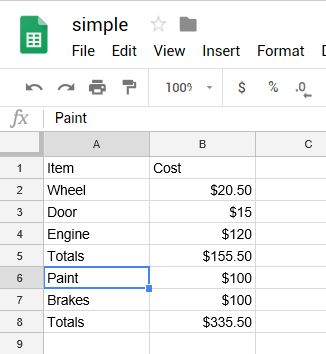
// Our Google Spreadsheet now looks like this:
//
// The JSON ValueRange for the cells in the above spreadsheet is:
// {
// "range": "Sheet1!A1:B5",
// "majorDimension": "ROWS",
// "values": [
// [
// "Item",
// "Cost"
// ],
// [
// "Wheel",
// "$20.50"
// ],
// [
// "Door",
// "$15"
// ],
// [
// "Engine",
// "$100"
// ],
// [
// "Totals",
// "$135.50"
// ]
// ]
// }
// This example will append 6 cells (3 rows / 2 columns).
// We'll be appending the following:
//
// "Paint", "$100"
// "Brakes", "$100"
// "New Total", "$335.50"
//
// The range of cells we'll be appending is A1:B5
// Therefore, the ValueRange JSON we'll be sending in our POST body is:
// {
// "range": "Sheet1!A1:B5",
// "majorDimension": "ROWS",
// "values": [
// [
// "Paint",
// "$100"
// ],
// [
// "Brakes",
// "$100"
// ],
// [
// "New Total",
// "$335.50"
// ]
// ]
// }
let json = chilkat::JsonObject::new();
let _ = json.update_string("range", "Sheet1!A1:B5");
let _ = json.update_string("majorDimension", "ROWS");
json.set_i(0);
json.set_j(1);
let _ = json.update_string("values[i][j]", "Paint");
json.set_j(1);
let _ = json.update_string("values[i][j]", "$100");
json.set_i(1);
json.set_j(0);
let _ = json.update_string("values[i][j]", "Brakes");
json.set_j(1);
let _ = json.update_string("values[i][j]", "$100");
json.set_i(2);
json.set_j(0);
let _ = json.update_string("values[i][j]", "Totals");
json.set_j(1);
let _ = json.update_string("values[i][j]", "$335.50");
json.set_emit_compact(false);
println!("{}", json.emit().unwrap_or_default());
// Send the POST to:
// https://sheets.googleapis.com/v4/spreadsheets/{spreadsheetId}/values/{range}:append?valueInputOption=USER_ENTERED
let _ = http.set_url_var("spreadsheetId", "1_SO2L-Y6nCayNpNppJLF0r9yHB2UnaCleGCKeE4O0SA");
let _ = http.set_url_var("range", "Sheet1!A1:B5");
let resp = chilkat::HttpResponse::new();
if http.http_json("POST", "https://sheets.googleapis.com/v4/spreadsheets/{$spreadsheetId}/values/{$range}:append?valueInputOption=USER_ENTERED", &json, "application/json", &resp).is_err() {
println!("{}", http.last_error_text());
return;
}
println!("response status code = {}", resp.status_code());
println!("response JSON = {}", resp.body_str());
// Sample output:
//
// response status code = 200
// response JSON = {
// "spreadsheetId": "1_SO2L-Y6nCayNpNppJLF0r9yHB2UnaCleGCKeE4O0SA",
// "tableRange": "Sheet1!A1:B5",
// "updates": {
// "spreadsheetId": "1_SO2L-Y6nCayNpNppJLF0r9yHB2UnaCleGCKeE4O0SA",
// "updatedRange": "Sheet1!A6:B8",
// "updatedRows": 3,
// "updatedColumns": 2,
// "updatedCells": 6
// }
// }
//
// Our Google Spreadsheet now looks like this:
//