React Native
React Native
MIME -- Convert Base64 to Binary
See more MIME Examples
Loads MIME containing a base64 body and converts it to binary. This changes the Content-Transfer-Encoding header to "binary", and the body is stored as raw unencoded bytes.The MIME file initially loaded in this example contains:
Content-Disposition: attachment; filename="starfish20.jpg"
Content-Type: image/jpeg; name="starfish20.jpg"
Content-Transfer-Encoding: base64

/9j/4AAQSkZJRgABAQEASABIAAD//gAmRmlsZSB3cml0dGVuIGJ5IEFkb2JlIFBob3Rvc2hvcD8g
NC4w/9sAQwAQCwwODAoQDg0OEhEQExgoGhgWFhgxIyUdKDozPTw5Mzg3QEhcTkBEV0U3OFBtUVdf
YmdoZz5NcXlwZHhcZWdj/9sAQwEREhIYFRgvGhovY0I4QmNjY2NjY2NjY2NjY2NjY2NjY2NjY2Nj
Y2NjY2NjY2NjY2NjY2NjY2NjY2NjY2NjY2Nj/8IAEQgAFAAUAwERAAIRAQMRAf/EABcAAAMBAAAA
AAAAAAAAAAAAAAIDBAX/xAAYAQADAQEAAAAAAAAAAAAAAAABAgMEAP/aAAwDAQACEAMQAAAB2kZY
NNEijWKddfTmLgALWH//xAAbEAACAgMBAAAAAAAAAAAAAAABAgMRAAQSE//aAAgBAQABBQL0XqN+
pM2aqJGMiqFFCyg7z//EABwRAAICAgMAAAAAAAAAAAAAAAERAAIQIQMSUf/aAAgBAwEBPwHqU5aq
Axx+y1tMQl4elj//xAAcEQEAAQUBAQAAAAAAAAAAAAABEQACEBIhA1H/2gAIAQIBAT8B3Bhqy7Zc
enyiwmGgDhiOzj//xAAdEAABAwUBAAAAAAAAAAAAAAABAAIREBIhIkFR/9oACAEBAAY/ArZyn+Cg
xtxWuJaoCnqDuin/xAAcEAABBAMBAAAAAAAAAAAAAAABABEhYRAxQVH/2gAIAQEAAT8hkEwPUUR9
DYfE4nxtRpIkBTsayuALIiuY/9oADAMBAAIAAwAAABDWPTsf/8QAGhEAAwADAQAAAAAAAAAAAAAA
AAEREDFBIf/aAAgBAwEBPxC0DVPcWm+Ce4OesrkE6bjH/8QAGBEBAQEBAQAAAAAAAAAAAAAAAREA
QRD/2gAIAQIBAT8QahMiOc8YgSrnTY3ELclHXn//xAAcEAEBAAIDAQEAAAAAAAAAAAABEQAhMUFx
EFH/2gAIAQEAAT8Qn3igmSZSj+c4N4zapMy9IjFV98wncN2iuLFsCEbDGxQkI6RO/n//2Q==
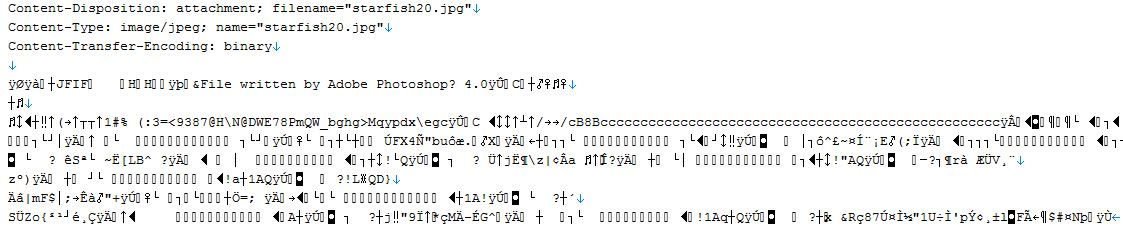
After converting, the binary MIME looks like the following. (Note: Loading it into a text editor and saving it will corrupt the binary data by dropping bytes. Non-text binary data CANNOT be handled as if it were text without corruption.)
Chilkat React Native Downloads
import { FileAccess, Mime } from '@chilkat/react-native'

function chilkatExample() {
  // This example requires the Chilkat API to have been previously unlocked.
  // See Global Unlock Sample for sample code.

  const mime = new Mime();

  try {
    mime.loadMimeFile('qa_data/mime/starfish20_base64.mim');
  } catch {
    console.log(mime.lastErrorText);
    return;
  }

  // Show the MIME.  We can see the body is base64 encoded.
  const mimeStr = mime.getMime();
  console.log(mimeStr);

  // Change the Content-Transfer-Encoding to "binary"
  mime.setHeaderField('Content-Transfer-Encoding', 'binary');

  // Note: Now that the MIME's body is binary (JPG image data),
  // we CANNOT get the MIME as a string.  We can only get it as bytes.

  const mimeBytes = mime.getMimeBytes();

  // We can save it to a file, and then examine it..
  const fac = new FileAccess();
  try {
    fac.writeEntireFile('qa_data/mime/starfish20_binary.mim', mimeBytes);
    console.log('Saved binary MIME.');
  } catch {
    console.log(fac.lastErrorText);
  }
}