PowerShell Requires Chilkat v9.5.0.85+
PowerShell
Sign PDF with Timestamp from TSA (Timestamp Server Authority)
See more PDF Signatures Examples
This example demonstrates how to a sign a PDF that is both long-term validation (LTV) enabled and includes a validating timestamp from a TSA (Timestamp Server Authority).Chilkat PowerShell Downloads
Add-Type -Path "C:\chilkat\ChilkatDotNet47-x64\ChilkatDotNet47.dll"

$success = $false

#  This example requires the Chilkat API to have been previously unlocked.
#  See Global Unlock Sample for sample code.

$pdf = New-Object Chilkat.Pdf

#  Load a PDF to be signed.
#  The "hello.pdf" is available at https://chilkatsoft.com/hello.pdf
$success = $pdf.LoadFile("qa_data/pdf/hello.pdf")
if ($success -eq $false) {
    $($pdf.LastErrorText)
    exit
}

#  Options for signing are specified in JSON.
$json = New-Object Chilkat.JsonObject

#  In most cases, the signingCertificateV2 and signingTime attributes are required.
$json.UpdateInt("signingCertificateV2",1)
$json.UpdateInt("signingTime",1)

#  Tell Chilkat to create an LTV-enabled (long term validation) signature.
#  See PDF Long-Term Validation (LTV) Signature Example for more detailed comments about "ltvOcsp".
$json.UpdateBool("ltvOcsp",$true)

#  Tell Chilkat to request a timestamp from a TSA server and include the timestamp token (1.2.840.113549.1.9.16.2.14)
#  in the CMS signature's authentication attributes
$json.UpdateBool("timestampToken.enabled",$true)

#  In this example, we'll use a free TSA server (timestamp.digicert.com), but you may want to use your own timestamp authority server.
$json.UpdateString("timestampToken.tsaUrl","http://timestamp.digicert.com")

#  If the timestamp server requires a username/password, do the following.  Otherwise omit the following few lines of code.
$json.UpdateString("timestampToken.tsaUsername","the_tsa_username")
$json.UpdateString("timestampToken.tsaPassword","the_tsa_password")

#  When requesting the timestamp token, ask the server to include its certificate in the timestamp token response.
#  This allows for the timestamp server's certificate to be included in the LTV validation (i.e. if the timestamp server
#  has an OCSP URL, then Chilkat will also do the OCSP request for the timestamp server's certificate.)
$json.UpdateBool("timestampToken.requestTsaCert",$true)

#  Define the appearance of the signature.
$json.UpdateInt("page",1)
$json.UpdateString("appearance.y","top")
$json.UpdateString("appearance.x","left")
$json.UpdateString("appearance.fontScale","10.0")
$json.UpdateString("appearance.text[0]","Digitally signed by: cert_cn")
$json.UpdateString("appearance.text[1]","current_dt")
$json.UpdateString("appearance.text[2]","This is an LTV-enabled signature with a TSA timestamp.")

#  Load the signing certificate. (Use your own certificate.)
$cert = New-Object Chilkat.Cert
$success = $cert.LoadPfxFile("qa_data/pfx/myPdfSigningCert.pfx","pfxPassword")
if ($success -eq $false) {
    $($cert.LastErrorText)
    exit
}

#  Tell the pdf object to use the certificate for signing.
$success = $pdf.SetSigningCert($cert)
if ($success -eq $false) {
    $($pdf.LastErrorText)
    exit
}

$success = $pdf.SignPdf($json,"qa_output/hello_ltv_signed_with_timestamp.pdf")
if ($success -eq $false) {
    $($pdf.LastErrorText)
    exit
}

$("The PDF has been successfully cryptographically signed with TSA timestamp and long-term validation.")

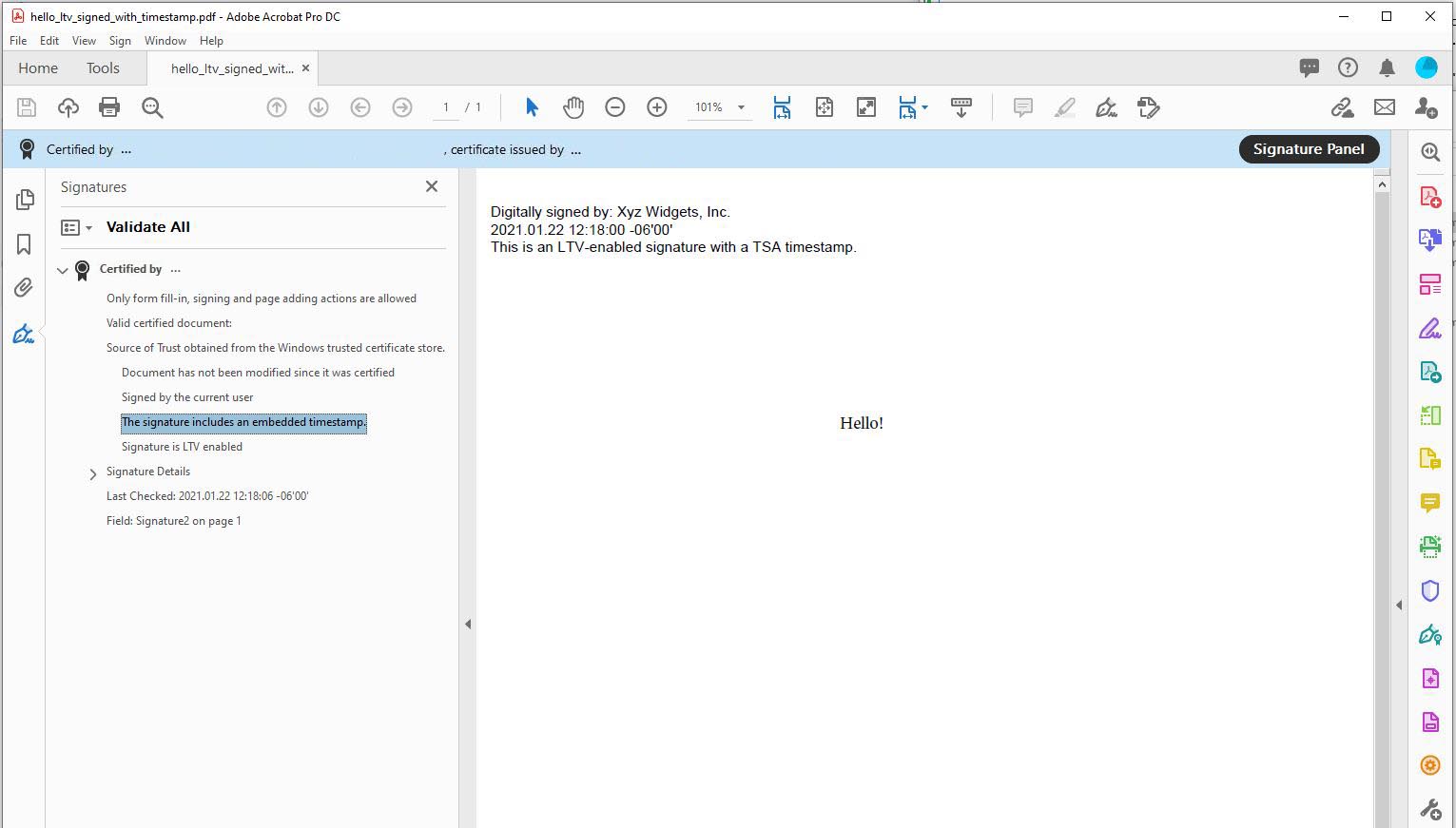
#  If you open the Signature Panel in Adobe Acrobat, it will indicate that the signature is LTV enabled
#  and contains an embedded timestamp:
#