PowerBuilder
PowerBuilder
Firebase PUT - Writing Data
See more Firebase Examples
Demonstrates how to PUT new data to a Firebase JSON database. The data used in this example is at Chilkat Firebase Pigs Database, and is shown here: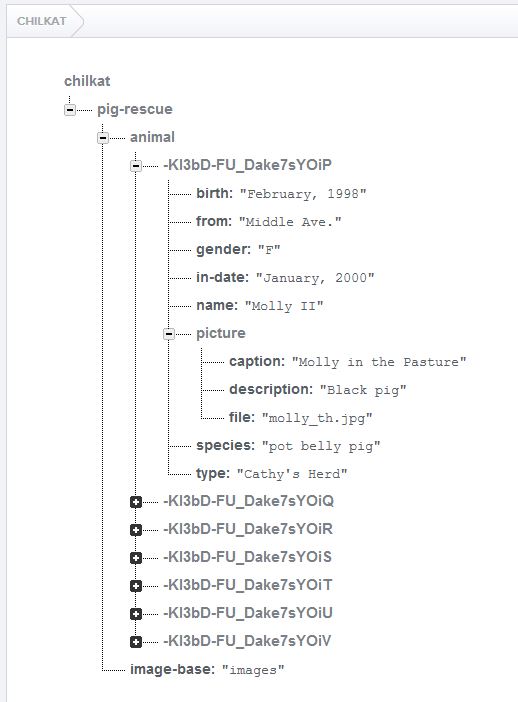
Chilkat PowerBuilder Downloads
integer li_rc
long li_Success
oleobject loo_Fac
string ls_AccessToken
oleobject loo_Rest
oleobject loo_AuthGoogle
oleobject loo_Prng
string ls_PushId
oleobject loo_PigRecord
oleobject loo_Path
string ls_JsonResponse

li_Success = 0

//  Demonstrates how to PUT new data to a Firebase JSON database.

//  This example requires the Chilkat API to have been previously unlocked.
//  See Global Unlock Sample for sample code.

//  This example assumes a JWT authentication token, if required, has been previously obtained.
//  See Get Firebase Access Token from JSON Service Account Private Key for sample code.

//  Load the previously obtained Firebase access token into a string.
loo_Fac = create oleobject
li_rc = loo_Fac.ConnectToNewObject("Chilkat.FileAccess")
if li_rc < 0 then
    destroy loo_Fac
    MessageBox("Error","Connecting to COM object failed")
    return
end if
ls_AccessToken = loo_Fac.ReadEntireTextFile("qa_data/tokens/firebaseToken.txt","utf-8")
if loo_Fac.LastMethodSuccess <> 1 then
    Write-Debug loo_Fac.LastErrorText
    destroy loo_Fac
    return
end if

loo_Rest = create oleobject
li_rc = loo_Rest.ConnectToNewObject("Chilkat.Rest")

//  Make the initial connection (without sending a request yet).
//  Once connected, any number of requests may be sent.  It is not necessary to explicitly
//  call Connect before each request.
li_Success = loo_Rest.Connect("chilkat.firebaseio.com",443,1,1)
if li_Success <> 1 then
    Write-Debug loo_Rest.LastErrorText
    destroy loo_Fac
    destroy loo_Rest
    return
end if

loo_AuthGoogle = create oleobject
li_rc = loo_AuthGoogle.ConnectToNewObject("Chilkat.AuthGoogle")

loo_AuthGoogle.AccessToken = ls_AccessToken
loo_Rest.SetAuthGoogle(loo_AuthGoogle)

//  Chilkat's sample data (pig-rescue data) is publicly readable at: https://chilkat.firebaseio.com/.json
//  This data is publicly readable, but not writable.  You'll need to
//  run against your own database..

//  Generate a new push ID.
loo_Prng = create oleobject
li_rc = loo_Prng.ConnectToNewObject("Chilkat.Prng")

ls_PushId = loo_Prng.FirebasePushId()

//  We're going to add a new pig with just the name.
loo_PigRecord = create oleobject
li_rc = loo_PigRecord.ConnectToNewObject("Chilkat.JsonObject")

loo_PigRecord.AppendString("name","William")

loo_Path = create oleobject
li_rc = loo_Path.ConnectToNewObject("Chilkat.StringBuilder")

loo_Path.Append("/pig-rescue/animal/")
loo_Path.Append(ls_PushId)
loo_Path.Append(".json")

//  The string content of the last arg passed is  {"name":"William"}
ls_JsonResponse = loo_Rest.FullRequestString("PUT",loo_Path.GetAsString(),loo_PigRecord.Emit())
if loo_Rest.LastMethodSuccess <> 1 then
    //  Something happened in the communications (either no request was sent, or no response was received.
    //  (The Chilkat REST API also has lower-level methods where an app can send the request in one call,
    //  and then receive the response in another call.)
    Write-Debug loo_Rest.LastErrorText
    destroy loo_Fac
    destroy loo_Rest
    destroy loo_AuthGoogle
    destroy loo_Prng
    destroy loo_PigRecord
    destroy loo_Path
    return
end if

//  Check the response status code.   A 200 response status indicates success.
if loo_Rest.ResponseStatusCode <> 200 then
    Write-Debug loo_Rest.ResponseStatusText
    Write-Debug ls_JsonResponse
    Write-Debug "Failed."
    destroy loo_Fac
    destroy loo_Rest
    destroy loo_AuthGoogle
    destroy loo_Prng
    destroy loo_PigRecord
    destroy loo_Path
    return
end if

Write-Debug ls_JsonResponse
Write-Debug "Success."

//  Note: In many of the Chilkat examples, you may notice strange ways
//  of doing something that should be simpler and shorter.  For example,
//  building the path (above) could've been written differently,
//  with some simple string concatenation.
//
//  The reason is that the Chilkat examples are written in a
//  proprietary "example code" scripting language,
//  and then automatically generated to each of the different programming
//  languages you see on example-code.com.  The code generation is
//  limited in what it can do.  For example, string concatentation
//  is not yet a feature of the "example code" scripting language (as of May 2016),
//  and therefore you won't see the use of a programming language's string
//  concatentation operators in any example.
//


destroy loo_Fac
destroy loo_Rest
destroy loo_AuthGoogle
destroy loo_Prng
destroy loo_PigRecord
destroy loo_Path