PHP Extension
PHP Extension
PDF Sign Under Existing Signature
See more PDF Signatures Examples
This example explains how sign a previously-signed PDF and place the signature appearance below the existing signature.Note: This example requires Chilkat v9.5.0.85 or greater.
Chilkat PHP Extension Downloads
<?php
include("chilkat.php");
$success = false;
// This example requires the Chilkat API to have been previously unlocked.
// See Global Unlock Sample for sample code.
$pdf = new CkPdf();
// Load a PDF to be signed.
$success = $pdf->LoadFile('qa_data/pdf/sign_testing_4/hello_signed.pdf');
if ($success == false) {
print $pdf->lastErrorText() . "\n";
exit;
}
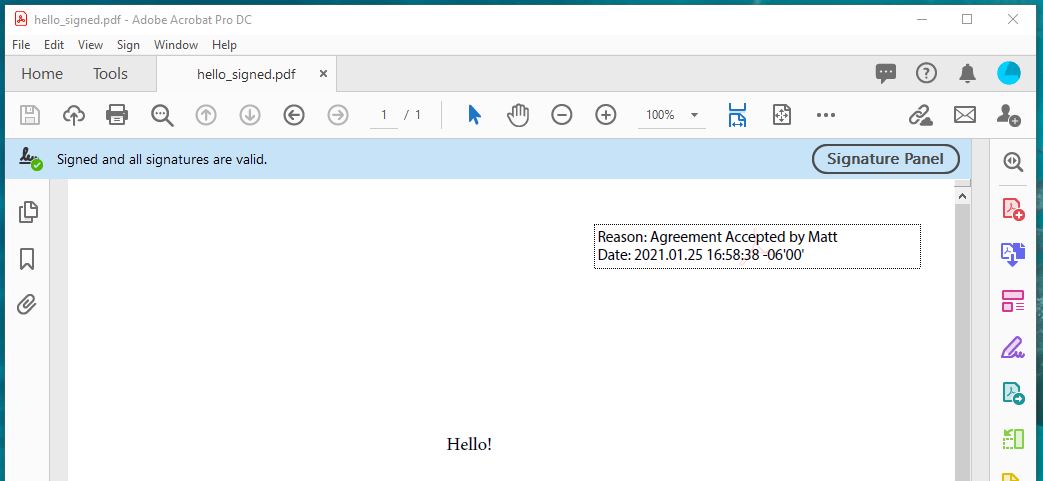
// The PDF we'll be signing already has a signature added in Adobe Acrobat DC.
// It looks like this:
// (Notice the Adobe background logo, which is commonly what you'll see when a signature
// is created by Adobe Acrobat. Chilkat (obviously) does not create signatures using the Adobe
// logo because it would be a copyright violation.)
//  // Options for signing are specified in JSON.
$json = new CkJsonObject();
// In most cases, the signingCertificateV2 and signingTime attributes are required.
$json->UpdateInt('signingCertificateV2',1);
$json->UpdateInt('signingTime',1);
// To put our new signature underneath the existing signature, we have to specify the page
// where the existing signature is found, and then we can specify "under" for the "appearance.y"
$json->UpdateInt('page',1);
$json->UpdateString('appearance.y','under');
$json->UpdateString('appearance.fontScale','10.0');
$json->UpdateString('appearance.text[0]','Reason: Agreement Accepted by John');
$json->UpdateString('appearance.text[1]','Date: current_dt');
// Load the signing certificate. (Use your own certificate.)
$cert = new CkCert();
$success = $cert->LoadPfxFile('qa_data/pfx/myPdfSigningCert.pfx','secret');
if ($success == false) {
print $cert->lastErrorText() . "\n";
exit;
}
// Tell the pdf object to use the certificate for signing.
$success = $pdf->SetSigningCert($cert);
if ($success == false) {
print $pdf->lastErrorText() . "\n";
exit;
}
// Note: When adding an additional signature to a PDF, the existing signatures
// are validated, and this includes validating the certificates previously used to
// create the existing signatures. (A signature typically embeds the signing certs.)
// In some cases, the certificates and/or certs in the chain of authentication for
// existing signatures are not present, and are not available on the current system.
// In this case, you can skip the validation by setting this keyword in UncommonOptions:
$pdf->put_UncommonOptions('NO_VERIFY_CERT_SIGNATURES');
$success = $pdf->SignPdf($json,'qa_output/hello_signed.pdf');
if ($success == false) {
print $pdf->lastErrorText() . "\n";
exit;
}
print 'The PDF has been successfully cryptographically signed.' . "\n";
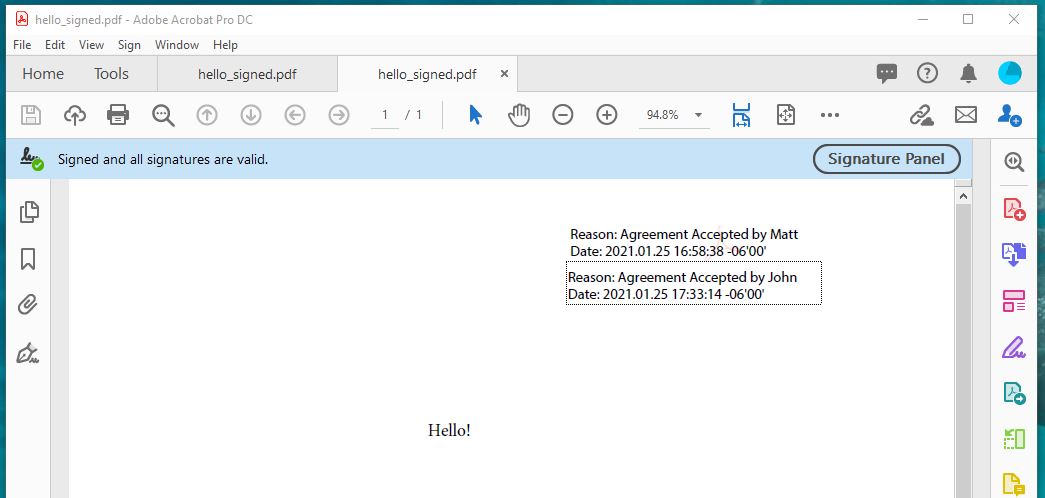
// Here's a screenshot of the 2nd signature positioned under the 1st in Adobe Acrobat:
//
// Options for signing are specified in JSON.
$json = new CkJsonObject();
// In most cases, the signingCertificateV2 and signingTime attributes are required.
$json->UpdateInt('signingCertificateV2',1);
$json->UpdateInt('signingTime',1);
// To put our new signature underneath the existing signature, we have to specify the page
// where the existing signature is found, and then we can specify "under" for the "appearance.y"
$json->UpdateInt('page',1);
$json->UpdateString('appearance.y','under');
$json->UpdateString('appearance.fontScale','10.0');
$json->UpdateString('appearance.text[0]','Reason: Agreement Accepted by John');
$json->UpdateString('appearance.text[1]','Date: current_dt');
// Load the signing certificate. (Use your own certificate.)
$cert = new CkCert();
$success = $cert->LoadPfxFile('qa_data/pfx/myPdfSigningCert.pfx','secret');
if ($success == false) {
print $cert->lastErrorText() . "\n";
exit;
}
// Tell the pdf object to use the certificate for signing.
$success = $pdf->SetSigningCert($cert);
if ($success == false) {
print $pdf->lastErrorText() . "\n";
exit;
}
// Note: When adding an additional signature to a PDF, the existing signatures
// are validated, and this includes validating the certificates previously used to
// create the existing signatures. (A signature typically embeds the signing certs.)
// In some cases, the certificates and/or certs in the chain of authentication for
// existing signatures are not present, and are not available on the current system.
// In this case, you can skip the validation by setting this keyword in UncommonOptions:
$pdf->put_UncommonOptions('NO_VERIFY_CERT_SIGNATURES');
$success = $pdf->SignPdf($json,'qa_output/hello_signed.pdf');
if ($success == false) {
print $pdf->lastErrorText() . "\n";
exit;
}
print 'The PDF has been successfully cryptographically signed.' . "\n";
// Here's a screenshot of the 2nd signature positioned under the 1st in Adobe Acrobat:
//  ?>
?>