Objective-C Requires Chilkat v10.1.2+
Objective-C
Rabobank OAuth2 Access Token
See more OAuth2 Examples
Demonstrates how to get an OAuth 2.0 access token to access Rabobank API'sImportant: This example is for desktop apps only. (It is not for web-based applications.)
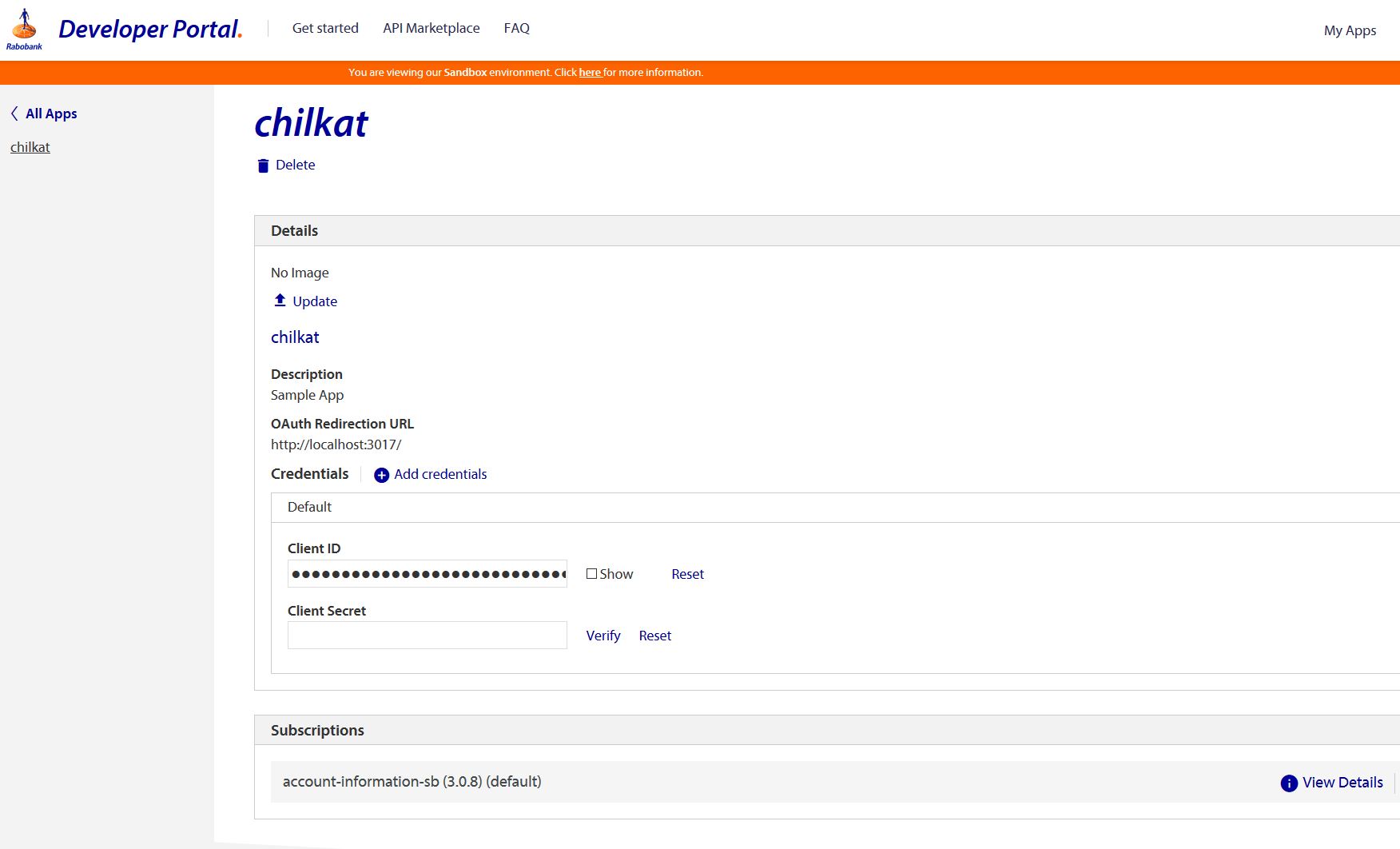
Your app defined in the Rabobank portal should look something like this. (Our test app is named "chilkat". You should name your app something else.)
Chilkat Objective-C Downloads
#import <CkoOAuth2.h>
#import <NSString.h>
#import <CkoJsonObject.h>
#import <CkoFileAccess.h>

BOOL success = NO;

//  For more information about the OAuth2, see OAuth 2.0 Authorization Flow

CkoOAuth2 *oauth2 = [[CkoOAuth2 alloc] init];

//  This should be the port in the localhost callback URL for your app.
//  The callback URL would look like "http://localhost:3017/" if the port number is 3017.
oauth2.ListenPort = [NSNumber numberWithInt:3017];

//  IMPORTANT: Don't forget to subscribe your Rabobank application to the OAuth 2.0 services in the Rabobank Online Developer Portal.
//  IMPORTANT: Don't forget to subscribe your Rabobank application to the OAuth 2.0 services in the Rabobank Online Developer Portal.
//  IMPORTANT: Don't forget to subscribe your Rabobank application to the OAuth 2.0 services in the Rabobank Online Developer Portal.
//  IMPORTANT: Don't forget to subscribe your Rabobank application to the OAuth 2.0 services in the Rabobank Online Developer Portal.

//  See also https://developer.rabobank.nl/faq

oauth2.AuthorizationEndpoint = @"https://api-sandbox.rabobank.nl/openapi/sandbox/oauth2/authorize";
oauth2.TokenEndpoint = @"https://api-sandbox.rabobank.nl/openapi/sandbox/oauth2/token";

//  Replace these with actual values.
oauth2.ClientId = @"YOUR_APP_CLIENT_ID";
//  This is your app password:
oauth2.ClientSecret = @"YOUR_APP_CLIENT_SECRET";

oauth2.CodeChallenge = NO;
//  Provide a SPACE separated list of scopes, as defined in the Rabobank API documentation,
//  such as at https://developer-sandbox.rabobank.nl/reference/accounts-ais-sb/3-0-8

//  Important: To get a refresh token in the final response, you have to ask for "offline_access" scope
oauth2.Scope = @"ais.balances.read ais.transactions.read-90days ais.transactions.read-history";

//  Begin the OAuth2 Authorization code flow.  This returns a URL that should be loaded in a browser.
NSString *url = [oauth2 StartAuth];
if (oauth2.LastMethodSuccess != YES) {
    NSLog(@"%@",oauth2.LastErrorText);
    return;
}

NSLog(@"%@%@",@"url = ",url);

//  Launch the default browser on the system and navigate to the url.
//  The LaunchBrowser method was added in Chilkat v10.1.2.
success = [oauth2 LaunchBrowser: url];
if (success == NO) {
    NSLog(@"%@",oauth2.LastErrorText);
    return;
}

//  Wait for the user to approve or deny authorization in the browser.
int numMsWaited = 0;
while ((numMsWaited < 90000) && ([oauth2.AuthFlowState intValue] < 3)) {
    [oauth2 SleepMs: [NSNumber numberWithInt: 100]];
    numMsWaited = numMsWaited + 100;
}

//  If the browser does not respond within the specified time, AuthFlowState will be:
//
//  1: Waiting for Redirect - The OAuth2 background thread is waiting for the browser's redirect request.
//  2: Waiting for Final Response - The thread is awaiting the final access token response.
//  In either case, cancel the background task initiated by StartAuth.

if ([oauth2.AuthFlowState intValue] < 3) {
    [oauth2 Cancel];
    NSLog(@"%@",@"No response from the browser!");
    return;
}

//  Check AuthFlowState to determine if authorization was granted, denied, or failed:
//
//  3: Success - OAuth2 flow completed, the background thread exited, and the successful response is in AccessTokenResponse.
//  4: Access Denied - OAuth2 flow completed, the background thread exited, and the error response is in AccessTokenResponse.
//  5: Failure - OAuth2 flow failed before completion, the background thread exited, and error details are in FailureInfo.

if ([oauth2.AuthFlowState intValue] == 5) {
    NSLog(@"%@",@"OAuth2 failed to complete.");
    NSLog(@"%@",oauth2.FailureInfo);
    return;
}

if ([oauth2.AuthFlowState intValue] == 4) {
    NSLog(@"%@",@"OAuth2 authorization was denied.");
    NSLog(@"%@",oauth2.AccessTokenResponse);
    return;
}

if ([oauth2.AuthFlowState intValue] != 3) {
    NSLog(@"%@%d",@"Unexpected AuthFlowState:",[oauth2.AuthFlowState intValue]);
    return;
}

NSLog(@"%@",@"OAuth2 authorization granted!");
NSLog(@"%@%@",@"Access Token = ",oauth2.AccessToken);

//  Get the full JSON response:
CkoJsonObject *json = [[CkoJsonObject alloc] init];
[json Load: oauth2.AccessTokenResponse];
json.EmitCompact = NO;

//  The JSON response looks like this:

//  {
//    "token_type": "Bearer",
//    "access_token": "AAIkYTU0ZWM ... sxE0KL0HHWw",
//    "expires_in": 3600,
//    "consented_on": 1584641121,
//    "scope": "ais.balances.read ais.transactions.read-90days ais.transactions.read-history",
//    "refresh_token": "AAJXXSdN ... Uiblz9ILkxNBlytRGA",
//    "refresh_token_expires_in": 157784760,
//    "expires_on": "1584644722"
//  }

NSLog(@"%@",[json Emit]);

//  Save the JSON to a file to be used in future requests.
CkoFileAccess *fac = [[CkoFileAccess alloc] init];
[fac WriteEntireTextFile: @"qa_data/tokens/rabobank.json" fileData: [json Emit] charset: @"utf-8" includePreamble: NO];