Delphi DLL Requires Chilkat v10.1.2+
Delphi DLL
X.com OAuth 2.0 Authorization Code with PKCE
See more X Examples
Demonstrates how to get an X.com OAuth2 access token from a desktop application or script.Chilkat Delphi DLL Downloads
var
success: Boolean;
oauth2: HCkOAuth2;
url: PWideChar;
numMsWaited: Integer;
json: HCkJsonObject;
dtExpire: HCkDateTime;
begin
success := False;
// For more information about the OAuth2, see OAuth 2.0 Authorization Flow
oauth2 := CkOAuth2_Create();
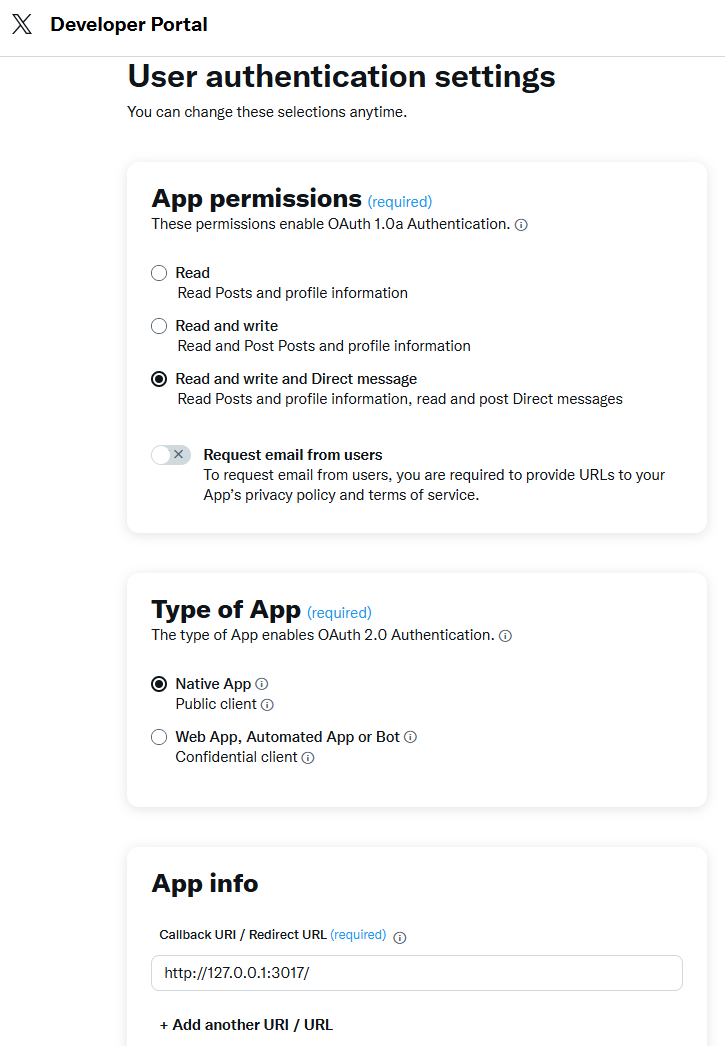
// The port should match the Authorized Redirect URL in your X.com app,
// which would look like "http://127.0.0.1:3017/"
// See the screenshot below of the App Settings in the X Developer Portal
CkOAuth2_putLocalHost(oauth2,'127.0.0.1');
CkOAuth2_putListenPort(oauth2,3017);
CkOAuth2_putAuthorizationEndpoint(oauth2,'https://x.com/i/oauth2/authorize');
CkOAuth2_putTokenEndpoint(oauth2,'https://api.x.com/2/oauth2/token');
// Replace this with your actual X.com OAuth2 Client ID and Client Secret
CkOAuth2_putClientId(oauth2,'OAUTH2_CLIENT_ID');
CkOAuth2_putClientSecret(oauth2,'OAUTH2_CLIENT_SECRET');
// This is for Require Proof Key for Code Exchange (PKCE)
// See OAuth2 PKCE Explained
CkOAuth2_putCodeChallenge(oauth2,True);
CkOAuth2_putCodeChallengeMethod(oauth2,'S256');
// Space separated scopes...
CkOAuth2_putScope(oauth2,'tweet.read tweet.write users.read follows.read follows.write offline.access like.read like.write block.read block.write');
// Begin the OAuth2 Authorization code flow. This returns a URL that should be loaded in a browser.
url := CkOAuth2__startAuth(oauth2);
if (CkOAuth2_getLastMethodSuccess(oauth2) <> True) then
begin
Memo1.Lines.Add(CkOAuth2__lastErrorText(oauth2));
Exit;
end;
Memo1.Lines.Add('url = ' + url);
// Launch the default browser on the system and navigate to the url.
// The LaunchBrowser method was added in Chilkat v10.1.2.
success := CkOAuth2_LaunchBrowser(oauth2,url);
if (success = False) then
begin
Memo1.Lines.Add(CkOAuth2__lastErrorText(oauth2));
Exit;
end;
// Wait for the user to approve or deny authorization in the browser.
numMsWaited := 0;
while (numMsWaited < 10000) and (CkOAuth2_getAuthFlowState(oauth2) < 3) do
begin
CkOAuth2_SleepMs(oauth2,100);
numMsWaited := numMsWaited + 100;
end;
// If the browser does not respond within the specified time, AuthFlowState will be:
//
// 1: Waiting for Redirect - The OAuth2 background thread is waiting for the browser's redirect request.
// 2: Waiting for Final Response - The thread is awaiting the final access token response.
// In either case, cancel the background task initiated by StartAuth.
if (CkOAuth2_getAuthFlowState(oauth2) < 3) then
begin
CkOAuth2_Cancel(oauth2);
Memo1.Lines.Add('No response from the browser!');
Exit;
end;
// Check AuthFlowState to determine if authorization was granted, denied, or failed:
//
// 3: Success - OAuth2 flow completed, the background thread exited, and the successful response is in AccessTokenResponse.
// 4: Access Denied - OAuth2 flow completed, the background thread exited, and the error response is in AccessTokenResponse.
// 5: Failure - OAuth2 flow failed before completion, the background thread exited, and error details are in FailureInfo.
if (CkOAuth2_getAuthFlowState(oauth2) = 5) then
begin
Memo1.Lines.Add('OAuth2 failed to complete.');
Memo1.Lines.Add(CkOAuth2__failureInfo(oauth2));
Exit;
end;
if (CkOAuth2_getAuthFlowState(oauth2) = 4) then
begin
Memo1.Lines.Add('OAuth2 authorization was denied.');
Memo1.Lines.Add(CkOAuth2__accessTokenResponse(oauth2));
Exit;
end;
if (CkOAuth2_getAuthFlowState(oauth2) <> 3) then
begin
Memo1.Lines.Add('Unexpected AuthFlowState:' + IntToStr(CkOAuth2_getAuthFlowState(oauth2)));
Exit;
end;
Memo1.Lines.Add('OAuth2 authorization granted!');
json := CkJsonObject_Create();
CkJsonObject_Load(json,CkOAuth2__accessTokenResponse(oauth2));
CkJsonObject_putEmitCompact(json,False);
// If an "expires_on" member does not exist, then add the JSON member by
// getting the current system date/time and adding the "expires_in" seconds.
// This way we'll know when the token expires.
if (CkJsonObject_HasMember(json,'expires_on') = False) then
begin
dtExpire := CkDateTime_Create();
CkDateTime_SetFromCurrentSystemTime(dtExpire);
CkDateTime_AddSeconds(dtExpire,CkJsonObject_IntOf(json,'expires_in'));
CkJsonObject_AppendString(json,'expires_on',CkDateTime__getAsUnixTimeStr(dtExpire,False));
end;
Memo1.Lines.Add('Access Token Response = ' + CkJsonObject__emit(json));
// A sample access token response:
// {
// "token_type": "bearer",
// "expires_in": 7200,
// "access_token": "VmNDLVZiYUZwejY5Mkx3RblFTmo3ek1leTRGclMuZFVOUTVUTWpNbVZKb1N5OjE3NDAxNjk4MDVxNTE6MToxOaF0OjE",
// "scope": "block.read follows.read offline.access tweet.write block.write like.write like.read users.read tweet.read follows.write",
// "refresh_token": "eThOWVVFSTRqdVp3QTFndGsxM2ZGZmFyNWVrU0phM1JKbGdrbGNWRGJzb1loOjE3NDAwMjk4MDUxNTI6MTowOnJ0OjE"
// }
Memo1.Lines.Add('Access Token = ' + CkOAuth2__accessToken(oauth2));
Memo1.Lines.Add('Refresh Token = ' + CkOAuth2__refreshToken(oauth2));
// Save the JSON access token response to a file for subsequent use..
CkJsonObject_WriteFile(json,'qa_data/tokens/x.json');
//  CkOAuth2_Dispose(oauth2);
CkJsonObject_Dispose(json);
CkDateTime_Dispose(dtExpire);
CkOAuth2_Dispose(oauth2);
CkJsonObject_Dispose(json);
CkDateTime_Dispose(dtExpire);