Chilkat2-Python Requires Chilkat v11.0.0+
Chilkat2-Python
PDF Signature Appearance Width and Height
See more PDF Signatures Examples
This example explains how the width and height of the signature appearance rectangle box is determined.Chilkat Chilkat2-Python Downloads
import sys
import chilkat2
success = False
# This example requires the Chilkat API to have been previously unlocked.
# See Global Unlock Sample for sample code.
pdf = chilkat2.Pdf()
# Load a PDF to be signed.
# The "hello.pdf" is available at https://chilkatsoft.com/hello.pdf
success = pdf.LoadFile("qa_data/pdf/hello.pdf")
if (success == False):
print(pdf.LastErrorText)
sys.exit()
# Options for signing are specified in JSON.
json = chilkat2.JsonObject()
# In most cases, the signingCertificateV2 and signingTime attributes are required.
json.UpdateInt("signingCertificateV2",1)
json.UpdateInt("signingTime",1)
# Put the signature on page 1, top left
json.UpdateInt("page",1)
json.UpdateString("appearance.y","top")
json.UpdateString("appearance.x","left")
# Add some text.
json.UpdateString("appearance.text[0]","Digitally signed by: cert_cn")
json.UpdateString("appearance.text[1]","current_dt")
# Add a built-in SVG graphic to the right.
json.UpdateString("appearance.image","blue-check-mark")
json.UpdateString("appearance.imagePlacement","right")
json.UpdateString("appearance.imageOpacity","100")
# There are 4 ways the width and height of the signature rectangle can be specified.
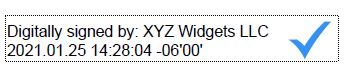
# 1) The width and height (in points) are both explicitly specified.
# User space coordinates use "points" where 72 points equals 1 inch.
# For example (3 inches wide and 1 inch high)
# The fontScale is automatically chose to fit. In addition, if a graphic (JPG or built-in SVG) is included,
# it is automatically scaled such that the text + graphic fit together in the specified rectangle.
# Note: When both height and width are explicitly specified, the resultant signature appearance rectangle
# will match one of the dimensions, but the other dimension will be equal or smaller. This is because the text
# must be proportionally scaled.
json.UpdateInt("appearance.width",72 * 3)
json.UpdateInt("appearance.height",72)
# The signature would have this appearance. In this case, the height is actually less than 1 inch because
# if Chilkat chose a fontScale to fill the height, the resulting text's width would be too long for the desired width.
#  # 2) The width is explicitly specified, but we use the keyword "auto" for height.
# In this case, the fontScale is chosen to achieve the desired width,
# and the height will be whatever the result of the chosen font scale.
# In this example, the width is 4 inches, and the height is "auto".
json.UpdateInt("appearance.width",72 * 4)
json.UpdateString("appearance.height","auto")
# The signature would have this appearance:
#
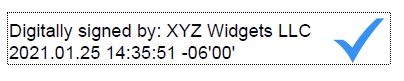
# 2) The width is explicitly specified, but we use the keyword "auto" for height.
# In this case, the fontScale is chosen to achieve the desired width,
# and the height will be whatever the result of the chosen font scale.
# In this example, the width is 4 inches, and the height is "auto".
json.UpdateInt("appearance.width",72 * 4)
json.UpdateString("appearance.height","auto")
# The signature would have this appearance:
#  # 3) The height is explicitly specified, but we use the keyword "auto" for width.
# In this case, the fontScale is chosen to achieve the desired height,
# and the width will be whatever the result of the chosen font scale.
# In this example, the height is 1 inch (72 points) and the width is "auto".
json.UpdateString("appearance.width","auto")
json.UpdateInt("appearance.height",72)
# The signature would have this appearance.
#
# 3) The height is explicitly specified, but we use the keyword "auto" for width.
# In this case, the fontScale is chosen to achieve the desired height,
# and the width will be whatever the result of the chosen font scale.
# In this example, the height is 1 inch (72 points) and the width is "auto".
json.UpdateString("appearance.width","auto")
json.UpdateInt("appearance.height",72)
# The signature would have this appearance.
#  # 4) Finally, we don't need to specify width/height at all. Instead, we can choose a fontScale
# and the dimensions of the PDF signature appearance's rectangle will be the result of using the
# specified fontScale.
jAppearance = chilkat2.JsonObject()
json.ObjectOf2("appearance",jAppearance)
jAppearance.Delete("width")
jAppearance.Delete("height")
json.UpdateString("appearance.fontScale","10.0")
# With fontScale = "10.0"
#
# 4) Finally, we don't need to specify width/height at all. Instead, we can choose a fontScale
# and the dimensions of the PDF signature appearance's rectangle will be the result of using the
# specified fontScale.
jAppearance = chilkat2.JsonObject()
json.ObjectOf2("appearance",jAppearance)
jAppearance.Delete("width")
jAppearance.Delete("height")
json.UpdateString("appearance.fontScale","10.0")
# With fontScale = "10.0"
#  # Load the signing certificate. (Use your own certificate.)
cert = chilkat2.Cert()
success = cert.LoadPfxFile("qa_data/pfx/myPdfSigningCert.pfx","pfx_password")
if (success == False):
print(cert.LastErrorText)
sys.exit()
# Tell the pdf object to use the certificate for signing.
success = pdf.SetSigningCert(cert)
if (success == False):
print(pdf.LastErrorText)
sys.exit()
success = pdf.SignPdf(json,"qa_output/hello_signed.pdf")
if (success == False):
print(pdf.LastErrorText)
sys.exit()
print("The PDF has been successfully cryptographically signed.")
# Load the signing certificate. (Use your own certificate.)
cert = chilkat2.Cert()
success = cert.LoadPfxFile("qa_data/pfx/myPdfSigningCert.pfx","pfx_password")
if (success == False):
print(cert.LastErrorText)
sys.exit()
# Tell the pdf object to use the certificate for signing.
success = pdf.SetSigningCert(cert)
if (success == False):
print(pdf.LastErrorText)
sys.exit()
success = pdf.SignPdf(json,"qa_output/hello_signed.pdf")
if (success == False):
print(pdf.LastErrorText)
sys.exit()
print("The PDF has been successfully cryptographically signed.")