Classic ASP
Classic ASP
ScMinidriver - Get Public Keys from Smart Card Key Container
See more ScMinidriver Examples
Demonstrates how to query a key container on a smart card (or USB token) to get the public part of the private keys that are present. A key container can hold two separate private keys -- one in the "signature" position, and the other in the "key exchange" position.Chilkat Classic ASP Downloads
<html>
<head>
<meta http-equiv="Content-Type" content="text/html; charset=utf-8">
</head>
<body>
<%
success = 0
' This example requires the Chilkat API to have been previously unlocked.
' See Global Unlock Sample for sample code.
' Chilkat recommends the following free tool for interactively examining the contents of your smart card
' through the ScMinidriver interface: MGTEK Tool for Minidriver enabled Smart Cards
' Let's first look at our smart card..
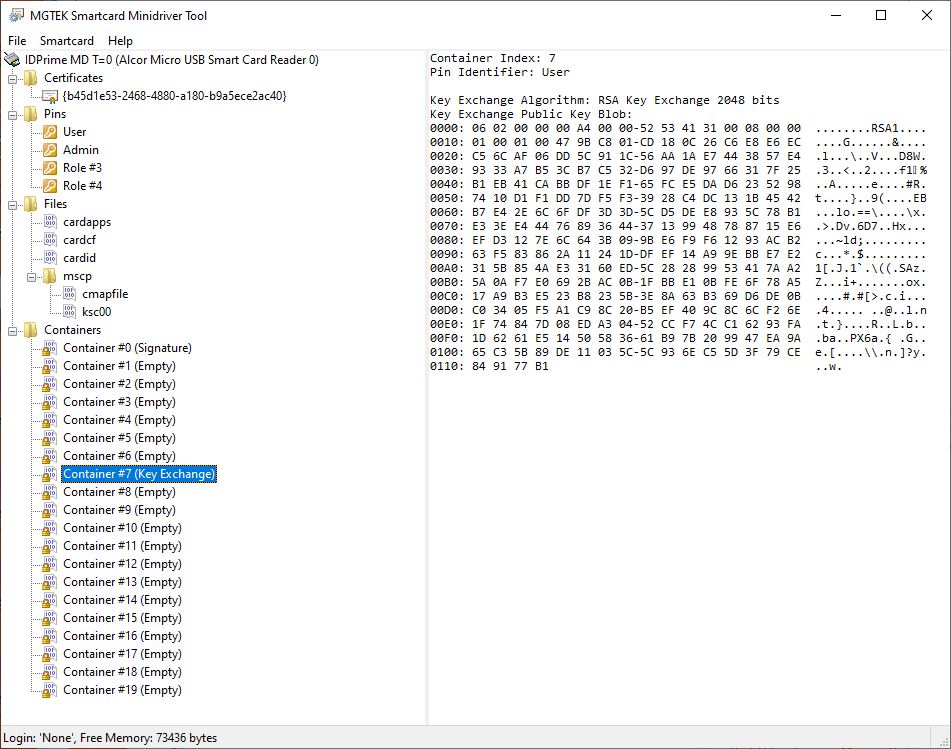
' Here's the view of our Gemalto (Thales) IDPrime MD T=0 smart card in the MGTEK tool:
'  set scmd = Server.CreateObject("Chilkat.ScMinidriver")
' First we need to acquire a context to the smart card in the reader where it is inserted.
' Reader names (smart card readers or USB tokens) can be discovered
' via List Readers or Find Smart Cards
readerName = "Alcor Micro USB Smart Card Reader 0"
success = scmd.AcquireContext(readerName)
If (success = 0) Then
Response.Write "<pre>" & Server.HTMLEncode( scmd.LastErrorText) & "</pre>"
Response.End
End If
' If successful, the name of the currently inserted smart card is available:
Response.Write "<pre>" & Server.HTMLEncode( "Card name: " & scmd.CardName) & "</pre>"
' We likely shouldn't need to authenticate with the smart card (use a PIN) to simply get a public key,
' so we can skip the PIN authenticatin step..
' Let's get the key(s) present in Container #7.
' In our case (shown in the image above), there is a private key in the "key exchange" position, but no key in the "signature" position.
set pubkey_sig = Server.CreateObject("Chilkat.PublicKey")
set pubkey_kex = Server.CreateObject("Chilkat.PublicKey")
success = scmd.GetContainerKeys(7,pubkey_sig,pubkey_kex)
If (success = 0) Then
Response.Write "<pre>" & Server.HTMLEncode( scmd.LastErrorText) & "</pre>"
Response.End
End If
If (pubkey_sig.Empty = 1) Then
Response.Write "<pre>" & Server.HTMLEncode( "No signature key is present.") & "</pre>"
Else
Response.Write "<pre>" & Server.HTMLEncode( "Signature key:") & "</pre>"
Response.Write "<pre>" & Server.HTMLEncode( pubkey_sig.GetPem(1)) & "</pre>"
End If
If (pubkey_kex.Empty = 1) Then
Response.Write "<pre>" & Server.HTMLEncode( "No Key Exchange key is present.") & "</pre>"
Else
Response.Write "<pre>" & Server.HTMLEncode( "Key Exchange key:") & "</pre>"
Response.Write "<pre>" & Server.HTMLEncode( pubkey_kex.GetPem(1)) & "</pre>"
End If
success = scmd.DeleteContext()
Response.Write "<pre>" & Server.HTMLEncode( "Success.") & "</pre>"
' Here's the output of the above sample code:
' Card name: IDPrime MD T=0
' No signature key is present.
' Key Exchange key:
' -----BEGIN RSA PUBLIC KEY-----
' MIIBCgKCAQEAsXeRhM55P13FbpNcXAMR3olbw2Wa6keZIHu5YTZYUBTlYWId+pNi
' wUz3zFIEo+0IfYR0H27ybIycQO+1IIzJofUFNMAL3tZps2OKPlsjuCPls6kXpXhv
' /gvhux8LrCtp4PcKWqJ6QVOZKChc7WAx40qFWzHi57ueqRTv3x0kESqGg/VjsqyT
' Evb55psJO2RsfhLT7+YVh3hImRM3RDaJdkTkPuOxeFyT6N7VXD09329sLuS3QkUb
' E9zEKDnz9X3d8dEQdJhSI9ba5fxl8R7fu8pB67ElfzFml96X1jLFtzy1pzOT5Fc4
' ROcaqlYckVzdBq9sxezm6MYmDBjNAcibRwIDAQAB
' -----END RSA PUBLIC KEY-----
%>
</body>
</html>
set scmd = Server.CreateObject("Chilkat.ScMinidriver")
' First we need to acquire a context to the smart card in the reader where it is inserted.
' Reader names (smart card readers or USB tokens) can be discovered
' via List Readers or Find Smart Cards
readerName = "Alcor Micro USB Smart Card Reader 0"
success = scmd.AcquireContext(readerName)
If (success = 0) Then
Response.Write "<pre>" & Server.HTMLEncode( scmd.LastErrorText) & "</pre>"
Response.End
End If
' If successful, the name of the currently inserted smart card is available:
Response.Write "<pre>" & Server.HTMLEncode( "Card name: " & scmd.CardName) & "</pre>"
' We likely shouldn't need to authenticate with the smart card (use a PIN) to simply get a public key,
' so we can skip the PIN authenticatin step..
' Let's get the key(s) present in Container #7.
' In our case (shown in the image above), there is a private key in the "key exchange" position, but no key in the "signature" position.
set pubkey_sig = Server.CreateObject("Chilkat.PublicKey")
set pubkey_kex = Server.CreateObject("Chilkat.PublicKey")
success = scmd.GetContainerKeys(7,pubkey_sig,pubkey_kex)
If (success = 0) Then
Response.Write "<pre>" & Server.HTMLEncode( scmd.LastErrorText) & "</pre>"
Response.End
End If
If (pubkey_sig.Empty = 1) Then
Response.Write "<pre>" & Server.HTMLEncode( "No signature key is present.") & "</pre>"
Else
Response.Write "<pre>" & Server.HTMLEncode( "Signature key:") & "</pre>"
Response.Write "<pre>" & Server.HTMLEncode( pubkey_sig.GetPem(1)) & "</pre>"
End If
If (pubkey_kex.Empty = 1) Then
Response.Write "<pre>" & Server.HTMLEncode( "No Key Exchange key is present.") & "</pre>"
Else
Response.Write "<pre>" & Server.HTMLEncode( "Key Exchange key:") & "</pre>"
Response.Write "<pre>" & Server.HTMLEncode( pubkey_kex.GetPem(1)) & "</pre>"
End If
success = scmd.DeleteContext()
Response.Write "<pre>" & Server.HTMLEncode( "Success.") & "</pre>"
' Here's the output of the above sample code:
' Card name: IDPrime MD T=0
' No signature key is present.
' Key Exchange key:
' -----BEGIN RSA PUBLIC KEY-----
' MIIBCgKCAQEAsXeRhM55P13FbpNcXAMR3olbw2Wa6keZIHu5YTZYUBTlYWId+pNi
' wUz3zFIEo+0IfYR0H27ybIycQO+1IIzJofUFNMAL3tZps2OKPlsjuCPls6kXpXhv
' /gvhux8LrCtp4PcKWqJ6QVOZKChc7WAx40qFWzHi57ueqRTv3x0kESqGg/VjsqyT
' Evb55psJO2RsfhLT7+YVh3hImRM3RDaJdkTkPuOxeFyT6N7VXD09329sLuS3QkUb
' E9zEKDnz9X3d8dEQdJhSI9ba5fxl8R7fu8pB67ElfzFml96X1jLFtzy1pzOT5Fc4
' ROcaqlYckVzdBq9sxezm6MYmDBjNAcibRwIDAQAB
' -----END RSA PUBLIC KEY-----
%>
</body>
</html>