Android™
Android™
Firebase DELETE - Removing Data
See more Firebase Examples
Uses the DELETE method to delete data. The data used in this example is at Chilkat Firebase Pigs Database, and is shown here: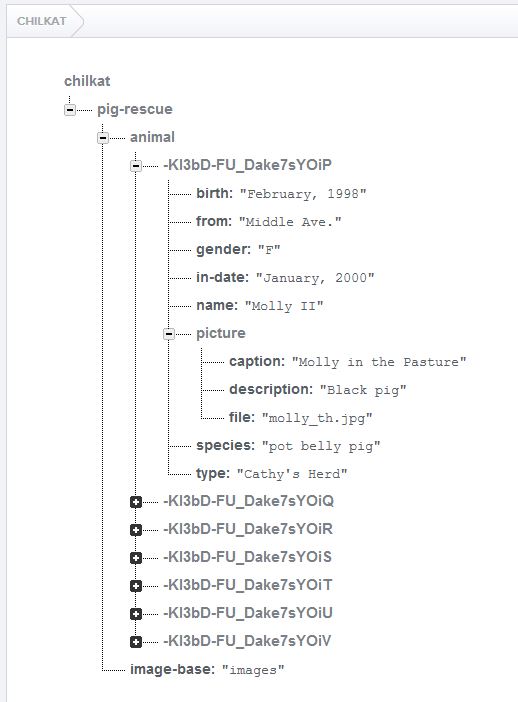
Chilkat Android™ Downloads
// Important: Don't forget to include the call to System.loadLibrary
// as shown at the bottom of this code sample.
package com.test;

import android.app.Activity;
import com.chilkatsoft.*;

import android.widget.TextView;
import android.os.Bundle;

public class SimpleActivity extends Activity {

  private static final String TAG = "Chilkat";

  // Called when the activity is first created.
  @Override
  public void onCreate(Bundle savedInstanceState) {
    super.onCreate(savedInstanceState);

    boolean success = false;

    //  Uses the DELETE method to delete a Firebase record.

    //  This example requires the Chilkat API to have been previously unlocked.
    //  See Global Unlock Sample for sample code.

    //  This example assumes a JWT authentication token, if required, has been previously obtained.
    //  See Get Firebase Access Token from JSON Service Account Private Key for sample code.

    //  Load the previously obtained Firebase access token into a string.
    CkFileAccess fac = new CkFileAccess();
    String accessToken = fac.readEntireTextFile("qa_data/tokens/firebaseToken.txt","utf-8");
    if (fac.get_LastMethodSuccess() != true) {
        Log.i(TAG, fac.lastErrorText());
        return;
        }

    CkRest rest = new CkRest();

    //  Make the initial connection (without sending a request yet).
    //  Once connected, any number of requests may be sent.  It is not necessary to explicitly
    //  call Connect before each request.
    success = rest.Connect("chilkat.firebaseio.com",443,true,true);
    if (success != true) {
        Log.i(TAG, rest.lastErrorText());
        return;
        }

    CkAuthGoogle authGoogle = new CkAuthGoogle();
    authGoogle.put_AccessToken(accessToken);
    rest.SetAuthGoogle(authGoogle);

    //  Chilkat's sample data (pig-rescue data) is publicly readable at: https://chilkat.firebaseio.com/.json
    //  This data is publicly readable, but not writable.  You'll need to
    //  run against your own database..

    //  We're going to delete a pig we previously added.  The push ID of that pig was -KI3pT33wKauiMxY4QTB,
    //  so the path will be "/pig-rescue/animal/-KI3pT33wKauiMxY4QTB.json"

    String jsonResponse = rest.fullRequestNoBody("DELETE","/pig-rescue/animal/-KI3pT33wKauiMxY4QTB.json");
    if (rest.get_LastMethodSuccess() != true) {
        //  Something happened in the communications (either no request was sent, or no response was received.
        //  (The Chilkat REST API also has lower-level methods where an app can send the request in one call,
        //  and then receive the response in another call.)
        Log.i(TAG, rest.lastErrorText());
        return;
        }

    //  Check the response status code.   A 200 response status indicates success.
    if (rest.get_ResponseStatusCode() != 200) {
        Log.i(TAG, rest.responseStatusText());
        Log.i(TAG, jsonResponse);
        Log.i(TAG, "Failed.");
        return;
        }

    Log.i(TAG, "Success.");

  }

  static {
      System.loadLibrary("chilkat");

      // Note: If the incorrect library name is passed to System.loadLibrary,
      // then you will see the following error message at application startup:
      //"The application <your-application-name> has stopped unexpectedly. Please try again."
  }
}