SQL Server
SQL Server
Salesforce OAuth2 Refresh Access Token
See more OAuth2 Examples
Demonstrates how to refresh a Salesforce Access Token.Note: Use Chilkat v10.1.2 or later for this example.
Chilkat SQL Server Downloads
-- Important: See this note about string length limitations for strings returned by sp_OAMethod calls.
--
CREATE PROCEDURE ChilkatSample
AS
BEGIN
DECLARE @hr int
-- Important: Do not use nvarchar(max). See the warning about using nvarchar(max).
DECLARE @sTmp0 nvarchar(4000)
DECLARE @success int
SELECT @success = 0
-- This example requires the Chilkat API to have been previously unlocked.
-- See Global Unlock Sample for sample code.
-- It is assumed we previously obtained an OAuth2 access token.
-- This example loads the JSON access token file
-- saved by this example: Get SalesForce OAuth2 Access Token via Authorization Flow
DECLARE @jsonToken int
EXEC @hr = sp_OACreate 'Chilkat.JsonObject', @jsonToken OUT
IF @hr <> 0
BEGIN
PRINT 'Failed to create ActiveX component'
RETURN
END
EXEC sp_OAMethod @jsonToken, 'LoadFile', @success OUT, 'qa_data/tokens/_salesforce.json'
IF @success <> 1
BEGIN
PRINT 'Failed to load _salesforce.json'
EXEC @hr = sp_OADestroy @jsonToken
RETURN
END
-- This is an example of a Salesforce OAuth2 access token to be refreshed:
-- {
-- "access_token": "00D41000....uLZBpT6",
-- "refresh_token": "5Aep....25xdGgkrV",
-- "signature": "cjTbSc5DvcKpaMoRTzuQTJLb1tcMw8LEO01flq4aMD4=",
-- "scope": "refresh_token id",
-- "instance_url": "https://d41000000f8a0eak-dev-ed.my.salesforce.com",
-- "id": "https://login.salesforce.com/id/00D41000000F8A0EAK/005410000....xAAE",
-- "token_type": "Bearer",
-- "issued_at": "1738348388166"
-- }
DECLARE @oauth2 int
EXEC @hr = sp_OACreate 'Chilkat.OAuth2', @oauth2 OUT
EXEC sp_OASetProperty @oauth2, 'TokenEndpoint', 'https://login.salesforce.com/services/oauth2/token'
-- Replace this with your actual client ID (Consumer Key)
EXEC sp_OASetProperty @oauth2, 'ClientId', 'CLIENT_ID'
-- Note: The client secret is not required because we configured our Connected App
-- to not require it for the refresh flow. See the screenshot below.
-- Get the "refresh_token"
EXEC sp_OAMethod @jsonToken, 'StringOf', @sTmp0 OUT, 'refresh_token'
EXEC sp_OASetProperty @oauth2, 'RefreshToken', @sTmp0
-- Send the HTTP POST to refresh the access token..
EXEC sp_OAMethod @oauth2, 'RefreshAccessToken', @success OUT
IF @success <> 1
BEGIN
EXEC sp_OAGetProperty @oauth2, 'LastErrorText', @sTmp0 OUT
PRINT @sTmp0
EXEC @hr = sp_OADestroy @jsonToken
EXEC @hr = sp_OADestroy @oauth2
RETURN
END
-- The response contains a new access token, but we must keep
-- our existing refresh token for when we need to refresh again in the future.
EXEC sp_OAGetProperty @oauth2, 'AccessToken', @sTmp0 OUT
EXEC sp_OAMethod @jsonToken, 'UpdateString', @success OUT, 'access_token', @sTmp0
-- Save the new JSON access token response to a file.
DECLARE @sbJson int
EXEC @hr = sp_OACreate 'Chilkat.StringBuilder', @sbJson OUT
EXEC sp_OASetProperty @jsonToken, 'EmitCompact', 0
EXEC sp_OAMethod @jsonToken, 'EmitSb', @success OUT, @sbJson
EXEC sp_OAMethod @sbJson, 'WriteFile', @success OUT, 'qa_data/tokens/_salesforce.json', 'utf-8', 0
PRINT 'OAuth2 authorization granted!'
EXEC sp_OAGetProperty @oauth2, 'AccessToken', @sTmp0 OUT
PRINT 'New Access Token = ' + @sTmp0
-- --------------------------------------------------------------------------
-- Here's a screenshot of a Salesforce Connected App
-- which does not requires the secret for the authorization or refresh flow.
-- 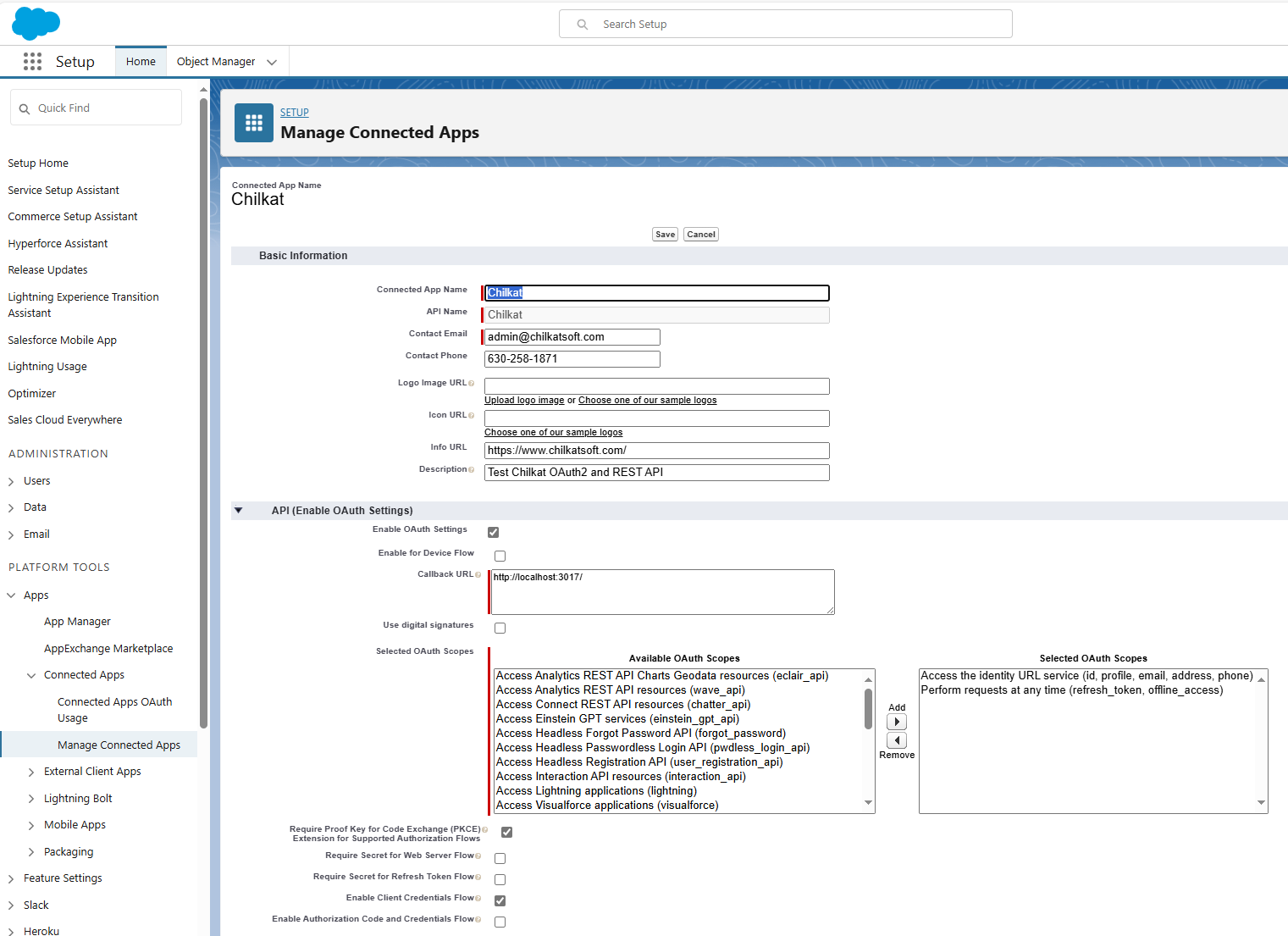 EXEC @hr = sp_OADestroy @jsonToken
EXEC @hr = sp_OADestroy @oauth2
EXEC @hr = sp_OADestroy @sbJson
END
GO
EXEC @hr = sp_OADestroy @jsonToken
EXEC @hr = sp_OADestroy @oauth2
EXEC @hr = sp_OADestroy @sbJson
END
GO