SQL Server
SQL Server
Sign PDF: Choosing RSASSA-PSS or PKCS1-v1_5 and Hash Algorithm
See more PDF Signatures Examples
This example demonstrates how to choose between RSASSA-PSS vs. PKCS1-v1_5 and the hash algorithm when signing a PDF.Chilkat SQL Server Downloads
--
CREATE PROCEDURE ChilkatSample
AS
BEGIN
DECLARE @hr int
DECLARE @sTmp0 nvarchar(4000)
DECLARE @success int
SELECT @success = 0
-- This example requires the Chilkat API to have been previously unlocked.
-- See Global Unlock Sample for sample code.
DECLARE @pdf int
EXEC @hr = sp_OACreate 'Chilkat.Pdf', @pdf OUT
IF @hr <> 0
BEGIN
PRINT 'Failed to create ActiveX component'
RETURN
END
-- Load a PDF to be signed.
-- The "hello.pdf" is available at https://chilkatsoft.com/hello.pdf
EXEC sp_OAMethod @pdf, 'LoadFile', @success OUT, 'qa_data/pdf/hello.pdf'
IF @success = 0
BEGIN
EXEC sp_OAGetProperty @pdf, 'LastErrorText', @sTmp0 OUT
PRINT @sTmp0
EXEC @hr = sp_OADestroy @pdf
RETURN
END
-- Options for signing are specified in JSON.
DECLARE @json int
EXEC @hr = sp_OACreate 'Chilkat.JsonObject', @json OUT
-- In most cases, the signingCertificateV2 attribute is needed.
EXEC sp_OAMethod @json, 'UpdateInt', @success OUT, 'signingCertificateV2', 1
-- ---------------------------------------------------------------------------------------------------------------------------
-- This example is the same as the example at Sign a PDF (Simplest Example Possible)
-- but with the following lines added to specify the signature scheme and hash algorithm.
-- The signature schemes PKCS-v1_5 and RSASSA-PSS have differences.
-- PKCSV1_5 is deterministic. The same message and key will produce an identical signature value each time.
-- PSS is randomized and will produce a different signature value each time.
-- To choose the hash algorithm:
-- (The typical choices are sha1, sha256, sha384, and sha512.)
EXEC sp_OAMethod @json, 'UpdateString', @success OUT, 'hashAlgorithm', 'sha256'
-- To choose PKCSV1_5:
EXEC sp_OAMethod @json, 'UpdateString', @success OUT, 'signingAlgorithm', 'pkcs'
-- Alternatively, to choose RSASSA-PSS:
EXEC sp_OAMethod @json, 'UpdateString', @success OUT, 'signingAlgorithm', 'pss'
-- If not specified, the default is SHA256 with PKCS-v1_5.
-- The remainder of this example is the same as the example at Sign a PDF (Simplest Example Possible)
-- ---------------------------------------------------------------------------------------------------------------------------
-- Put the signature on page 1, top left
EXEC sp_OAMethod @json, 'UpdateInt', @success OUT, 'page', 1
EXEC sp_OAMethod @json, 'UpdateString', @success OUT, 'appearance.y', 'top'
EXEC sp_OAMethod @json, 'UpdateString', @success OUT, 'appearance.x', 'left'
-- Use a font scale of 10.0
EXEC sp_OAMethod @json, 'UpdateString', @success OUT, 'appearance.fontScale', '10.0'
-- In this example, the appearance of the digital signature will contain three lines:
-- 1) The signing certificate's common name
-- 2) The current date/time
-- 3) Some arbitrary text.
-- The keyword "cert_cn" is replaced with the Certificate's Subject Common Name.
-- The keyword "current_dt" is replaced with the current date/time.
-- Any number of appearance text lines can be added.
EXEC sp_OAMethod @json, 'UpdateString', @success OUT, 'appearance.text[0]', 'Digitally signed by: cert_cn'
EXEC sp_OAMethod @json, 'UpdateString', @success OUT, 'appearance.text[1]', 'current_dt'
EXEC sp_OAMethod @json, 'UpdateString', @success OUT, 'appearance.text[2]', 'The crazy brown fox jumps over the lazy dog.'
-- Load the signing certificate. (Use your own certificate.)
DECLARE @cert int
EXEC @hr = sp_OACreate 'Chilkat.Cert', @cert OUT
EXEC sp_OAMethod @cert, 'LoadPfxFile', @success OUT, 'qa_data/pfx/myPdfSigningCert.pfx', 'secret'
IF @success = 0
BEGIN
EXEC sp_OAGetProperty @cert, 'LastErrorText', @sTmp0 OUT
PRINT @sTmp0
EXEC @hr = sp_OADestroy @pdf
EXEC @hr = sp_OADestroy @json
EXEC @hr = sp_OADestroy @cert
RETURN
END
-- Tell the pdf object to use the certificate for signing.
EXEC sp_OAMethod @pdf, 'SetSigningCert', @success OUT, @cert
IF @success = 0
BEGIN
EXEC sp_OAGetProperty @pdf, 'LastErrorText', @sTmp0 OUT
PRINT @sTmp0
EXEC @hr = sp_OADestroy @pdf
EXEC @hr = sp_OADestroy @json
EXEC @hr = sp_OADestroy @cert
RETURN
END
EXEC sp_OAMethod @pdf, 'SignPdf', @success OUT, @json, 'qa_output/hello_signed.pdf'
IF @success = 0
BEGIN
EXEC sp_OAGetProperty @pdf, 'LastErrorText', @sTmp0 OUT
PRINT @sTmp0
EXEC @hr = sp_OADestroy @pdf
EXEC @hr = sp_OADestroy @json
EXEC @hr = sp_OADestroy @cert
RETURN
END
PRINT 'The PDF has been successfully cryptographically signed.'
-- The appearance of the signature appears in Adobe Acrobat as shown here:
-- 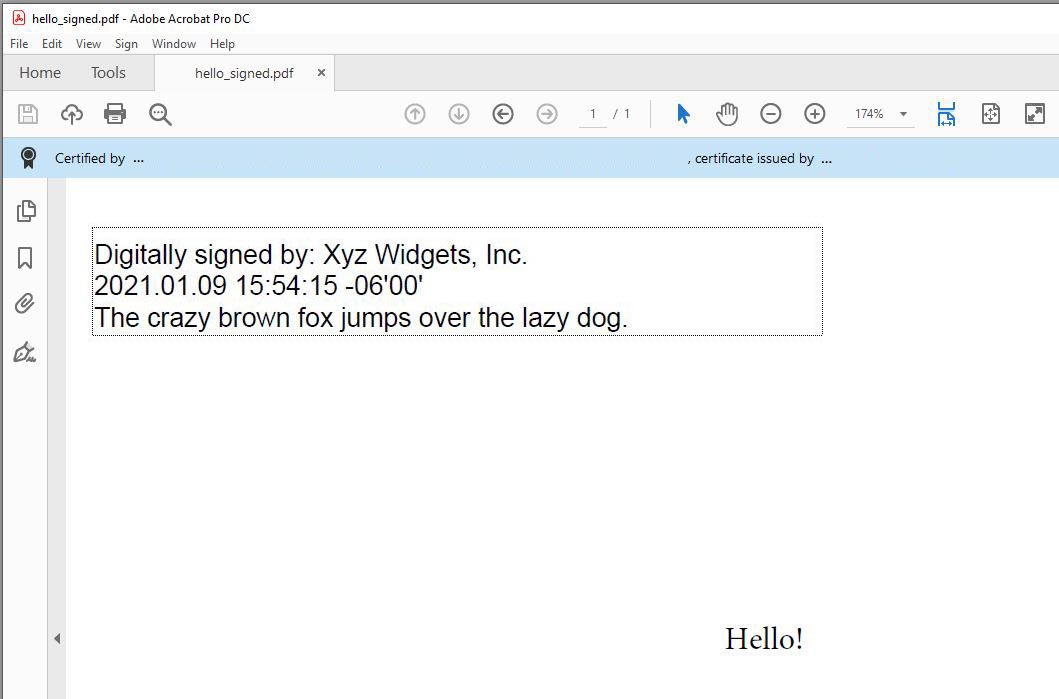 EXEC @hr = sp_OADestroy @pdf
EXEC @hr = sp_OADestroy @json
EXEC @hr = sp_OADestroy @cert
END
GO
EXEC @hr = sp_OADestroy @pdf
EXEC @hr = sp_OADestroy @json
EXEC @hr = sp_OADestroy @cert
END
GO