SQL Server
SQL Server
Sign PDF with Long-Term Validation (LTV Enabled)
See more PDF Signatures Examples
This example demonstrates how to a sign a PDF with long-term validation (LTV) enabled.Note: This example requires Chilkat v9.5.0.85 or greater.
Chilkat SQL Server Downloads
--
CREATE PROCEDURE ChilkatSample
AS
BEGIN
DECLARE @hr int
DECLARE @sTmp0 nvarchar(4000)
DECLARE @success int
SELECT @success = 0
-- This example requires the Chilkat API to have been previously unlocked.
-- See Global Unlock Sample for sample code.
DECLARE @pdf int
EXEC @hr = sp_OACreate 'Chilkat.Pdf', @pdf OUT
IF @hr <> 0
BEGIN
PRINT 'Failed to create ActiveX component'
RETURN
END
-- Load a PDF to be signed.
-- The "hello.pdf" is available at https://chilkatsoft.com/hello.pdf
EXEC sp_OAMethod @pdf, 'LoadFile', @success OUT, 'qa_data/pdf/hello.pdf'
IF @success = 0
BEGIN
EXEC sp_OAGetProperty @pdf, 'LastErrorText', @sTmp0 OUT
PRINT @sTmp0
EXEC @hr = sp_OADestroy @pdf
RETURN
END
-- Options for signing are specified in JSON.
DECLARE @json int
EXEC @hr = sp_OACreate 'Chilkat.JsonObject', @json OUT
-- In most cases, the signingCertificateV2 and signingTime attributes are required.
EXEC sp_OAMethod @json, 'UpdateInt', @success OUT, 'signingCertificateV2', 1
EXEC sp_OAMethod @json, 'UpdateInt', @success OUT, 'signingTime', 1
-- Add the "ltvOcsp" instruction to the JSON passed to SignPdf.
-- This is what causes Chilkat to create an LTV-enabled signature.
--
-- If we are signing a PDF that already has signatures, then the existing signatures
-- are automatically verified, and Chilkat will do OCSP certificate status checking (if possible)
-- for those certs in existing signatures (including certs in the certificate chains)
-- that do not yet have a valid OCSP response in the DSS (Document Security Store).
-- Chilkat will add the OCSP responses to the /OCSPs in the Document Security Store (/DSS).
-- Also, and certificates from existing signatures not yet in the DSS are added to the /Certs
-- in the DSS.
--
-- Also, the "ltvOcsp" causes Chilkat to add the pdfRevocationInfoArchival authenticated attribute
-- to the CMS signature. The pdfRevocationInfoArchival attribute (1.2.840.113583.1.1.8)
-- contains OCSP responses and the CRL for the issuer of the signing certificate.
-- Therefore, Chilkat will send an OCSP request to the signing certificate's OCSP URl (if one exists)
-- and will download the CRL from the issuer certificate's CRL Distribution Point (if one exists).
EXEC sp_OAMethod @json, 'UpdateBool', @success OUT, 'ltvOcsp', 1
-- -----------------------------------------------------------------------------------
-- Note: If Chilkat produces a signed PDF, but the signature is not LTV-enabled,
-- the cause might be related to a failure to download CRL's or OCSP requests.
-- See Possible Solution for Failure to Produce LTV-enabled PDF Signature
-- -----------------------------------------------------------------------------------
-- You can add the following to UncommonOptions to get detailed information about the CRL and OCSP requests
-- You shouldn't set the following logging options unless there is a need, because it adds a large amount of information to the LastErrorText.
EXEC sp_OASetProperty @pdf, 'UncommonOptions', 'LOG_OCSP_HTTP,LOG_CRL_HTTP'
-- Define the appearance of the signature.
EXEC sp_OAMethod @json, 'UpdateInt', @success OUT, 'page', 1
EXEC sp_OAMethod @json, 'UpdateString', @success OUT, 'appearance.y', 'top'
EXEC sp_OAMethod @json, 'UpdateString', @success OUT, 'appearance.x', 'left'
EXEC sp_OAMethod @json, 'UpdateString', @success OUT, 'appearance.fontScale', '10.0'
EXEC sp_OAMethod @json, 'UpdateString', @success OUT, 'appearance.text[0]', 'Digitally signed by: cert_cn'
EXEC sp_OAMethod @json, 'UpdateString', @success OUT, 'appearance.text[1]', 'current_dt'
EXEC sp_OAMethod @json, 'UpdateString', @success OUT, 'appearance.text[2]', 'This is an LTV-enabled signature.'
-- Load the signing certificate. (Use your own certificate.)
DECLARE @cert int
EXEC @hr = sp_OACreate 'Chilkat.Cert', @cert OUT
EXEC sp_OAMethod @cert, 'LoadPfxFile', @success OUT, 'qa_data/pfx/myPdfSigningCert.pfx', 'pfxPassword'
IF @success = 0
BEGIN
EXEC sp_OAGetProperty @cert, 'LastErrorText', @sTmp0 OUT
PRINT @sTmp0
EXEC @hr = sp_OADestroy @pdf
EXEC @hr = sp_OADestroy @json
EXEC @hr = sp_OADestroy @cert
RETURN
END
-- Tell the pdf object to use the certificate for signing.
EXEC sp_OAMethod @pdf, 'SetSigningCert', @success OUT, @cert
IF @success = 0
BEGIN
EXEC sp_OAGetProperty @pdf, 'LastErrorText', @sTmp0 OUT
PRINT @sTmp0
EXEC @hr = sp_OADestroy @pdf
EXEC @hr = sp_OADestroy @json
EXEC @hr = sp_OADestroy @cert
RETURN
END
EXEC sp_OAMethod @pdf, 'SignPdf', @success OUT, @json, 'qa_output/hello_ltv_signed.pdf'
IF @success = 0
BEGIN
EXEC sp_OAGetProperty @pdf, 'LastErrorText', @sTmp0 OUT
PRINT @sTmp0
EXEC @hr = sp_OADestroy @pdf
EXEC @hr = sp_OADestroy @json
EXEC @hr = sp_OADestroy @cert
RETURN
END
PRINT 'The PDF has been successfully cryptographically signed with long-term validation.'
-- If you open the Signature Panel in Adobe Acrobat, it will indicate that the signature is LTV enabled
-- as shown here:
-- 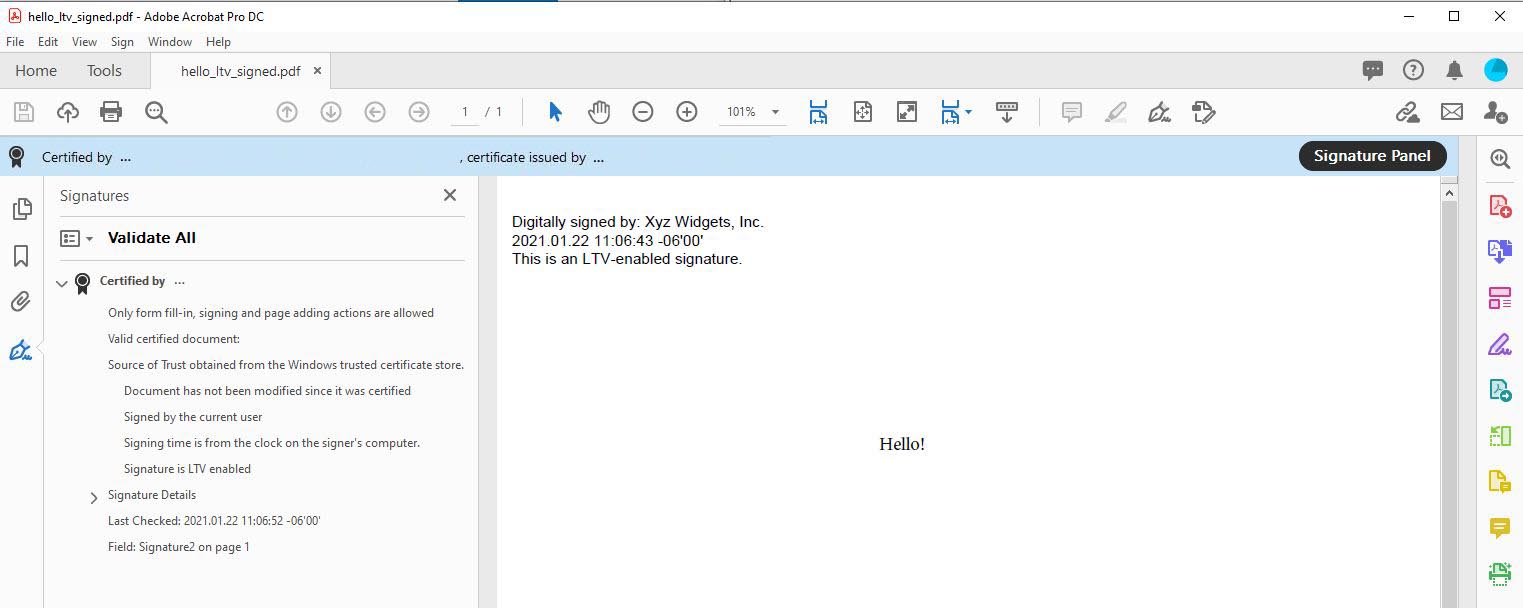 EXEC @hr = sp_OADestroy @pdf
EXEC @hr = sp_OADestroy @json
EXEC @hr = sp_OADestroy @cert
END
GO
EXEC @hr = sp_OADestroy @pdf
EXEC @hr = sp_OADestroy @json
EXEC @hr = sp_OADestroy @cert
END
GO