SQL Server
SQL Server
Dropbox: Access Your Own Account
See more Dropbox Examples
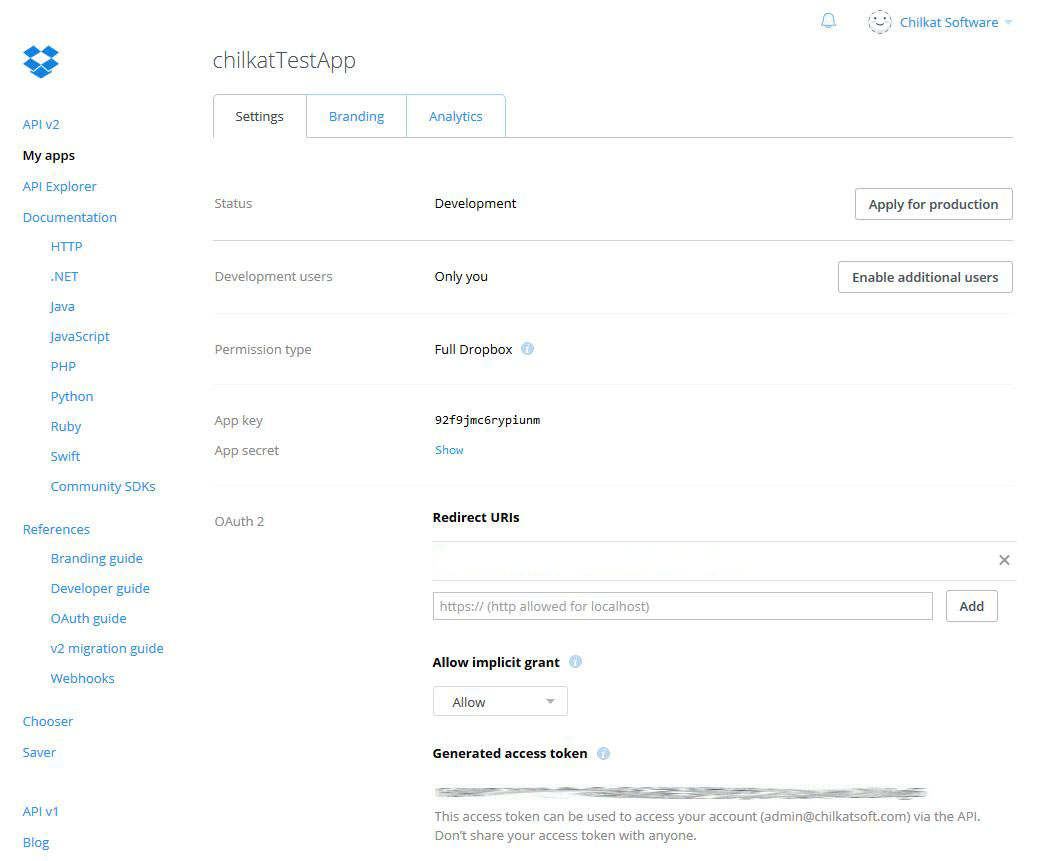
To programmatically interact with your own Dropbox account, such as for uploading, downloading, listing files, etc., go to the Dropbox app console and create an application. Then generate an access token in the online app console as shown in the screenshot below. The access token does not expire, and can be used to access your own account from your own non-web application.The example code, located below the screenshot, shows how to list the files in the root folder.
Chilkat SQL Server Downloads
-- Important: See this note about string length limitations for strings returned by sp_OAMethod calls.
--
CREATE PROCEDURE ChilkatSample
AS
BEGIN
    DECLARE @hr int
    DECLARE @iTmp0 int
    DECLARE @iTmp1 int
    DECLARE @iTmp2 int
    DECLARE @sTmp0 nvarchar(4000)
    DECLARE @success int
    SELECT @success = 0

    --  This example requires the Chilkat API to have been previously unlocked.
    --  See Global Unlock Sample for sample code.

    DECLARE @rest int
    EXEC @hr = sp_OACreate 'Chilkat.Rest', @rest OUT
    IF @hr <> 0
    BEGIN
        PRINT 'Failed to create ActiveX component'
        RETURN
    END

    --  Connect to the www.dropbox.com endpoint.
    DECLARE @bTls int
    SELECT @bTls = 1
    DECLARE @port int
    SELECT @port = 443
    DECLARE @bAutoReconnect int
    SELECT @bAutoReconnect = 1
    EXEC sp_OAMethod @rest, 'Connect', @success OUT, 'api.dropboxapi.com', @port, @bTls, @bAutoReconnect
    IF @success = 0
      BEGIN
        EXEC sp_OAGetProperty @rest, 'LastErrorText', @sTmp0 OUT
        PRINT @sTmp0
        EXEC @hr = sp_OADestroy @rest
        RETURN
      END

    EXEC sp_OAMethod @rest, 'AddHeader', @success OUT, 'Content-Type', 'application/json'
    EXEC sp_OAMethod @rest, 'AddHeader', @success OUT, 'Authorization', 'Bearer DROPBOX-ACCESS-TOKEN'

    DECLARE @json int
    EXEC @hr = sp_OACreate 'Chilkat.JsonObject', @json OUT

    --  The root folder should be an empty string, not "/"
    EXEC sp_OAMethod @json, 'AppendString', @success OUT, 'path', ''
    EXEC sp_OAMethod @json, 'AppendBool', @success OUT, 'recursive', 0
    EXEC sp_OAMethod @json, 'AppendBool', @success OUT, 'include_media_info', 0
    EXEC sp_OAMethod @json, 'AppendBool', @success OUT, 'include_deleted', 0
    EXEC sp_OAMethod @json, 'AppendBool', @success OUT, 'include_has_explicit_shared_members', 0

    DECLARE @responseStr nvarchar(4000)
    EXEC sp_OAMethod @json, 'Emit', @sTmp0 OUT
    EXEC sp_OAMethod @rest, 'FullRequestString', @responseStr OUT, 'POST', '/2/files/list_folder', @sTmp0
    EXEC sp_OAGetProperty @rest, 'LastMethodSuccess', @iTmp0 OUT
    IF @iTmp0 = 0
      BEGIN
        EXEC sp_OAGetProperty @rest, 'LastErrorText', @sTmp0 OUT
        PRINT @sTmp0
        EXEC @hr = sp_OADestroy @rest
        EXEC @hr = sp_OADestroy @json
        RETURN
      END

    --  Success is indicated by a 200 response status code.
    EXEC sp_OAGetProperty @rest, 'ResponseStatusCode', @iTmp0 OUT
    IF @iTmp0 <> 200
      BEGIN
        --  Examine the request/response to see what happened.

        EXEC sp_OAGetProperty @rest, 'ResponseStatusCode', @iTmp0 OUT
        PRINT 'response status code = ' + @iTmp0

        EXEC sp_OAGetProperty @rest, 'ResponseStatusText', @sTmp0 OUT
        PRINT 'response status text = ' + @sTmp0

        EXEC sp_OAGetProperty @rest, 'ResponseHeader', @sTmp0 OUT
        PRINT 'response header: ' + @sTmp0

        PRINT 'response body (if any): ' + @responseStr

        PRINT '---'

        EXEC sp_OAGetProperty @rest, 'LastRequestStartLine', @sTmp0 OUT
        PRINT 'LastRequestStartLine: ' + @sTmp0

        EXEC sp_OAGetProperty @rest, 'LastRequestHeader', @sTmp0 OUT
        PRINT 'LastRequestHeader: ' + @sTmp0
        EXEC @hr = sp_OADestroy @rest
        EXEC @hr = sp_OADestroy @json
        RETURN
      END

    DECLARE @jsonResponse int
    EXEC @hr = sp_OACreate 'Chilkat.JsonObject', @jsonResponse OUT

    EXEC sp_OAMethod @jsonResponse, 'Load', @success OUT, @responseStr

    EXEC sp_OASetProperty @jsonResponse, 'EmitCompact', 0
    EXEC sp_OAMethod @jsonResponse, 'Emit', @sTmp0 OUT
    PRINT @sTmp0

    --  A sample JSON response is shown at the end of this example.
    --  The following code iterates over the entries.
    DECLARE @dt int
    EXEC @hr = sp_OACreate 'Chilkat.DtObj', @dt OUT

    DECLARE @numEntries int
    EXEC sp_OAMethod @jsonResponse, 'SizeOfArray', @numEntries OUT, 'entries'
    DECLARE @i int
    SELECT @i = 0
    WHILE @i < @numEntries
      BEGIN
        EXEC sp_OASetProperty @jsonResponse, 'I', @i

        PRINT '----'

        EXEC sp_OAMethod @jsonResponse, 'StringOf', @sTmp0 OUT, 'entries[i].name'
        PRINT 'name: ' + @sTmp0

        EXEC sp_OAMethod @jsonResponse, 'StringOf', @sTmp0 OUT, 'entries[i].path_lower'
        PRINT 'path_lower: ' + @sTmp0

        EXEC sp_OAMethod @jsonResponse, 'StringOf', @sTmp0 OUT, 'entries[i].path_display'
        PRINT 'path_display: ' + @sTmp0
        EXEC sp_OAMethod @jsonResponse, 'HasMember', @iTmp0 OUT, 'entries[i].sharing_info'
        IF @iTmp0 = 1
          BEGIN

            PRINT 'has sharing_info...'

            EXEC sp_OAMethod @jsonResponse, 'StringOf', @sTmp0 OUT, 'entries[i].sharing_info.read_only'
            PRINT 'read_only: ' + @sTmp0

            EXEC sp_OAMethod @jsonResponse, 'StringOf', @sTmp0 OUT, 'entries[i].sharing_info.shared_folder_id'
            PRINT 'shared_folder_id: ' + @sTmp0
          END
        EXEC sp_OAMethod @jsonResponse, 'HasMember', @iTmp0 OUT, 'entries[i].client_modified'
        IF @iTmp0 = 1
          BEGIN
            --  Demonstrate how to parse a date/time:
            DECLARE @ckdt int
            EXEC @hr = sp_OACreate 'Chilkat.CkDateTime', @ckdt OUT

            EXEC sp_OAMethod @jsonResponse, 'StringOf', @sTmp0 OUT, 'entries[i].client_modified'
            EXEC sp_OAMethod @ckdt, 'SetFromTimestamp', @success OUT, @sTmp0
            --  The date/time can now be converted to many other formats, or the individual parts
            --  can be accessed.
            DECLARE @bLocalDateTime int
            SELECT @bLocalDateTime = 1
            EXEC sp_OAMethod @ckdt, 'ToDtObj', NULL, @bLocalDateTime, @dt

            EXEC sp_OAGetProperty @dt, 'Year', @iTmp0 OUT

            EXEC sp_OAGetProperty @dt, 'Month', @iTmp1 OUT

            EXEC sp_OAGetProperty @dt, 'Day', @iTmp2 OUT
            PRINT @iTmp0 + '-' + @iTmp1 + '-' + @iTmp2
          END
        SELECT @i = @i + 1
      END


    PRINT 'Success.'

    --  {
    --    "entries": [
    --      {
    --        ".tag": "folder",
    --        "name": "chilkat Team Folder",
    --        "path_lower": "/chilkat team folder",
    --        "path_display": "/chilkat Team Folder",
    --        "id": "id:2VqX9RLr-JAAAAAAAAAAAQ",
    --        "shared_folder_id": "1210954290",
    --        "sharing_info": {
    --          "read_only": false,
    --          "shared_folder_id": "1210954290"
    --        }
    --      },
    --      {
    --        ".tag": "file",
    --        "name": "Get Started with Dropbox.pdf",
    --        "path_lower": "/get started with dropbox.pdf",
    --        "path_display": "/Get Started with Dropbox.pdf",
    --        "id": "id:oxE2oMDqH4AAAAAAAAAAAQ",
    --        "client_modified": "2016-05-07T11:47:47Z",
    --        "server_modified": "2016-05-07T11:47:47Z",
    --        "rev": "1483db13f",
    --        "size": 692088
    --      }
    --    ],
    --    "cursor": "AAEnZXciJyS4gzC_tlX6K2na4c8o7_09-dxmXKHpkPPyf3Kl0H4N-VYnz424nCrFOJuhMiM5_RgNAersumx9qe7NgCSdlppr80iFk0gf6vPlecM6SBtLcs6OYXL8ILWiZ62pfnOvgC3WKGlG6dqZ-VXH",
    --    "has_more": false
    --  }
    --

    EXEC @hr = sp_OADestroy @rest
    EXEC @hr = sp_OADestroy @json
    EXEC @hr = sp_OADestroy @jsonResponse
    EXEC @hr = sp_OADestroy @dt
    EXEC @hr = sp_OADestroy @ckdt


END
GO