Delphi DLL
Delphi DLL
Get OAuth2 Access Token for Azure Registered App
See more OAuth2 Examples
Demonstrates how to get OAuth2 access token for an Azure Registered App from a desktop application or script. This example demonstrates the OAuth2 authorization flow.This example requires Chilkat v10.1.2 or greater.
Chilkat Delphi DLL Downloads
uses
Winapi.Windows, Winapi.Messages, System.SysUtils, System.Variants, System.Classes, Vcl.Graphics,
Vcl.Controls, Vcl.Forms, Vcl.Dialogs, Vcl.StdCtrls, FileAccess, OAuth2, JsonObject, CkDateTime;
...
procedure TForm1.Button1Click(Sender: TObject);
var
success: Boolean;
oauth2: HCkOAuth2;
url: PWideChar;
numMsWaited: Integer;
json: HCkJsonObject;
dtExpire: HCkDateTime;
fac: HCkFileAccess;
begin
success := False;
// To further clarify, see OAuth 2.0 Authorization Flow
oauth2 := CkOAuth2_Create();
// This should be the port in the localhost callback URL for your app.
// The callback URL would look like "http://localhost:3017/" if the port number is 3017.
CkOAuth2_putListenPort(oauth2,3017);
// ----------------------------------------------------------------------------------------------------------
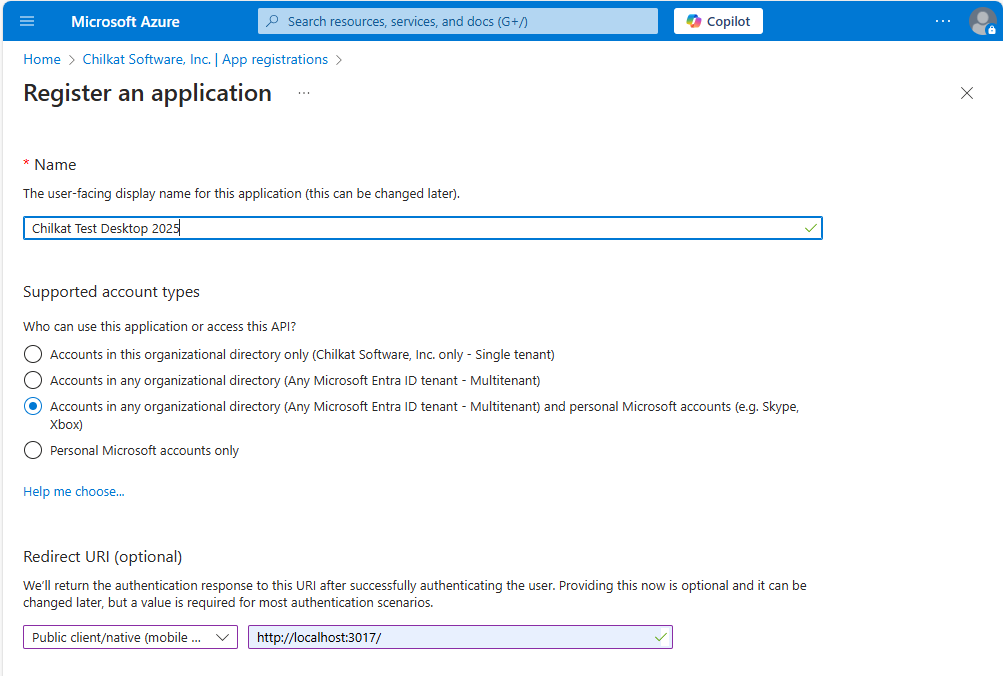
// The screenshot at the bottom of this page shows how we created the Azure App Registration for this example.
// ----------------------------------------------------------------------------------------------------------
// Note: The endpoint depends on the Azure App Registration.
// See How to Choose the Correct Endpoints for your Azure App Registration
CkOAuth2_putAuthorizationEndpoint(oauth2,'https://login.microsoftonline.com/common/oauth2/v2.0/authorize');
CkOAuth2_putTokenEndpoint(oauth2,'https://login.microsoftonline.com/common/oauth2/v2.0/token');
// Replace these with actual values.
CkOAuth2_putClientId(oauth2,'CLIENT_ID');
// This is for Require Proof Key for Code Exchange (PKCE)
// See OAuth2 PKCE Explained
CkOAuth2_putCodeChallenge(oauth2,True);
CkOAuth2_putCodeChallengeMethod(oauth2,'S256');
// Provide a SPACE separated list of scopes.
// See https://developer.microsoft.com/en-us/graph/docs/authorization/permission_scopes
// Important: To get a refresh token in the final response, ask for "offline_access" scope
CkOAuth2_putScope(oauth2,'openid profile offline_access user.readwrite mail.readwrite mail.send files.readwrite');
// Begin the OAuth2 three-legged flow. This returns a URL that should be loaded in a browser.
url := CkOAuth2__startAuth(oauth2);
if (CkOAuth2_getLastMethodSuccess(oauth2) <> True) then
begin
Memo1.Lines.Add(CkOAuth2__lastErrorText(oauth2));
Exit;
end;
// Launch the default browser on the system and navigate to the url.
// The LaunchBrowser method was added in Chilkat v10.1.2.
success := CkOAuth2_LaunchBrowser(oauth2,url);
if (success = False) then
begin
Memo1.Lines.Add(CkOAuth2__lastErrorText(oauth2));
Exit;
end;
// Wait for the user to approve or deny authorization in the browser.
numMsWaited := 0;
while (numMsWaited < 90000) and (CkOAuth2_getAuthFlowState(oauth2) < 3) do
begin
CkOAuth2_SleepMs(oauth2,100);
numMsWaited := numMsWaited + 100;
end;
// If the browser does not respond within the specified time, AuthFlowState will be:
//
// 1: Waiting for Redirect – The OAuth2 background thread is waiting for the browser's redirect request.
// 2: Waiting for Final Response – The thread is awaiting the final access token response.
// In either case, cancel the background task initiated by StartAuth.
if (CkOAuth2_getAuthFlowState(oauth2) < 3) then
begin
CkOAuth2_Cancel(oauth2);
Memo1.Lines.Add('No response from the browser!');
Exit;
end;
// Check AuthFlowState to determine if authorization was granted, denied, or failed:
//
// 3: Success – OAuth2 flow completed, the background thread exited, and the successful response is in AccessTokenResponse.
// 4: Access Denied – OAuth2 flow completed, the background thread exited, and the error response is in AccessTokenResponse.
// 5: Failure – OAuth2 flow failed before completion, the background thread exited, and error details are in FailureInfo.
if (CkOAuth2_getAuthFlowState(oauth2) = 5) then
begin
Memo1.Lines.Add('OAuth2 failed to complete.');
Memo1.Lines.Add(CkOAuth2__failureInfo(oauth2));
Exit;
end;
if (CkOAuth2_getAuthFlowState(oauth2) = 4) then
begin
Memo1.Lines.Add('OAuth2 authorization was denied.');
Memo1.Lines.Add(CkOAuth2__accessTokenResponse(oauth2));
Exit;
end;
if (CkOAuth2_getAuthFlowState(oauth2) <> 3) then
begin
Memo1.Lines.Add('Unexpected AuthFlowState:' + IntToStr(CkOAuth2_getAuthFlowState(oauth2)));
Exit;
end;
Memo1.Lines.Add('OAuth2 authorization granted!');
Memo1.Lines.Add('Access Token = ' + CkOAuth2__accessToken(oauth2));
// When the token is near expiration, your app can refresh as shown here:
// Refresh Expiring OAuth2 Access Token for Azure Registered App
// Get the full JSON response:
json := CkJsonObject_Create();
CkJsonObject_Load(json,CkOAuth2__accessTokenResponse(oauth2));
CkJsonObject_putEmitCompact(json,False);
// The JSON response looks like this:
// {
// "token_type": "Bearer",
// "scope": "User.Read Mail.ReadWrite Mail.Send",
// "expires_in": 3600,
// "ext_expires_in": 0,
// "access_token": "EwBAA8l6B...",
// "refresh_token": "MCRMdbe...",
// "id_token": "eyJ0eXA..."
// }
// If an "expires_on" member does not exist, then add the JSON member by
// getting the current system date/time and adding the "expires_in" seconds.
// This way we'll know when the token expires.
if (CkJsonObject_HasMember(json,'expires_on') <> True) then
begin
dtExpire := CkDateTime_Create();
CkDateTime_SetFromCurrentSystemTime(dtExpire);
CkDateTime_AddSeconds(dtExpire,CkJsonObject_IntOf(json,'expires_in'));
CkJsonObject_AppendString(json,'expires_on',CkDateTime__getAsUnixTimeStr(dtExpire,False));
end;
Memo1.Lines.Add(CkJsonObject__emit(json));
// Save the JSON to a file for future requests.
fac := CkFileAccess_Create();
CkFileAccess_WriteEntireTextFile(fac,'qa_data/tokens/_myAzureApp.json',CkJsonObject__emit(json),'utf-8',False);
// This is a screenshot of how we created the Azure App for this example:
//  CkOAuth2_Dispose(oauth2);
CkJsonObject_Dispose(json);
CkDateTime_Dispose(dtExpire);
CkFileAccess_Dispose(fac);
end;
CkOAuth2_Dispose(oauth2);
CkJsonObject_Dispose(json);
CkDateTime_Dispose(dtExpire);
CkFileAccess_Dispose(fac);
end;